Premium vs Budget Plush: What You're Really Paying For
Why one plush costs $3 and another $15 — the fabric, fill, stitch, embroidery, safety and QC that separate premium from cheap, how to spot a low-quality plush, and why cheapest is a false economy.

Two plush can look identical on a screen and cost five times apart. The difference isn't the logo — it's the fabric you can't feel through a photo, the fill that springs back or doesn't, the seams that hold or split, and the testing that never made the listing. This is the quality-desk guide to what your money actually buys, how to spot a cheap plush in under a minute, and why the lowest quote is usually the most expensive choice.
The $3 vs $15 question
Price tracks construction and safety, not branding. A premium plush isn't one expensive thing — it's a dozen small decisions (denser fabric, better fill, more stitches, embroidered features, real testing) stacked together. A budget plush cuts most of those corners at once. Understanding the drivers lets you buy deliberately instead of by sticker price.
The six quality drivers
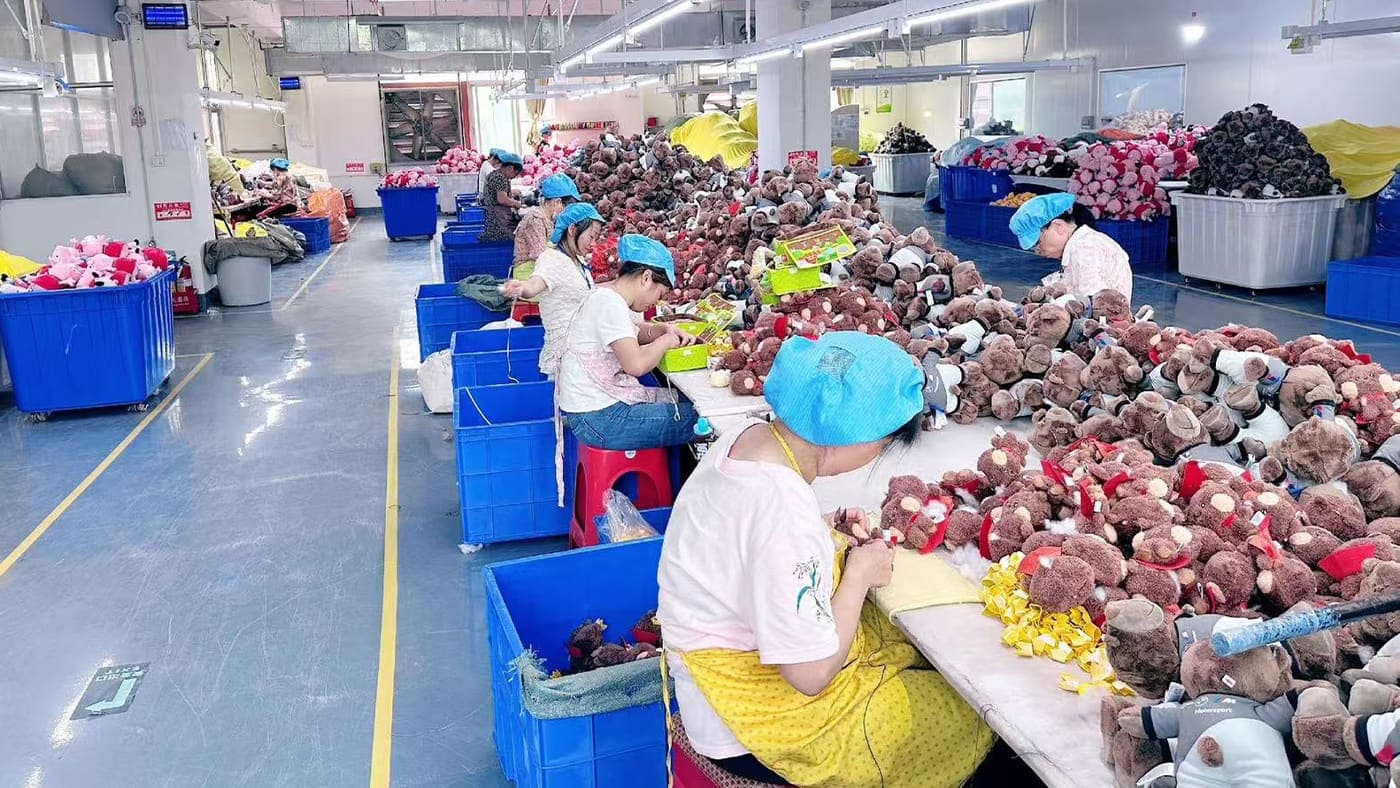
- Fabric— density (GSM) and pile uniformity. Quality plush fabric commonly runs ~180–300 GSM; premium uses dense minky/velboa, budget uses thin PV that sheds and pills. (Higher GSM isn't automatically “better” — it's matched to the product.)
- Fill — even, resilient loft that springs back, versus lumpy, grainy fill that collapses. Grade and even distribution matter more than virgin-vs-recycled.
- Stitch— roughly 10–12 stitches per inch and double-locked seams at stress points, versus loose, single-pass stitching with visible gaps. (Appropriate and consistent beats simply “more.”)
- Embroidery vs printed/glued features — dense, well-aligned embroidery with quality thread, versus printed or glued faces that fade and peel.
- Securely attached parts & symmetry— firmly anchored eyes/nose, level ears, a centered, on-model “face.”
- Finishing — trimmed threads, clean closed seams, consistent color across panels.
Budget vs standard vs premium: side by side
| Driver | Budget | Standard | Premium |
|---|---|---|---|
| Fabric | Thin PV, sheds/pills | Mid PV / velboa | Dense minky, low shed |
| Fill | Reclaimed, lumpy | Virgin PP | High-grade, even loft |
| Stitch | Loose, single-pass | Even, ~10–12 SPI | Reinforced, double-locked |
| Features | Printed / glued | Embroidered | Dense, registered embroidery |
| Testing | Often none | Basic | Full ASTM F963 / EN 71 + AQL |
How to spot a cheap plush in 60 seconds
A quick hands-on check tells you most of what a spec sheet would:
- Squeeze & release — quality fill springs back evenly; cheap fill stays dented or feels lumpy and hollow in spots.
- Tug a seam gently — look for tight, even stitching with no gaps or peeking stuffing.
- Check the face — eyes level and symmetric, features crisp and embroidered (not printed or glued), expression on-model.
- Rub the fur — quality pile doesn't shed onto your hand or pill; cheap PV does.
- Smell it — a strong chemical odor is a red flag for untested materials.
- Pull an eye/nose (firmly) — it must not loosen; a detachable part is a choking hazard and a failed toy.
Quality you can't see: QC & AQL
The biggest quality difference is invisible at the shelf: whether quality was verified or just assumed. Reputable factories run documented AQL inspections (Acceptance Quality Limit, under ISO 2859-1) — a defined sample is pulled and a set number of defects tolerated, with zero critical defects; toys are commonly inspected at AQL 2.5 for major and 4.0 for minor defects. On top of that sit accredited lab tests to ASTM F963 and EN 71 (the 90 N eye pull test, flammability, chemical limits) and OEKO-TEX material certification. AQL describes a sampling standard, not a promise every unit is flawless — but skipping it is exactly how cheap plush ships defects. The detail is in our QC & AQL guide.
Why the cheapest quote is a false economy
Quality is cheaper than it looks once you count the whole cost. A defect caught at the raw-material stage costs a few cents; the same defect caught in production costs more, in finished goods more still, at the customer more again, and at a recall it's catastrophic — the classic 1-10-100 escalation of the cost of quality. Cheap plush concentrates risk in exactly the failure modes that drive toy recalls — loose parts and untested materials — so the few cents saved per unit are swamped by returns, chargebacks, lost reorders and brand damage. (Recall and cost-of-quality figures vary widely and are cross-industry, but the direction is universal.) Price the total cost, not the sticker. Our pricing guide and MOQ & cost-breakdown guide show where the money really goes.
Buy on quality, not just price
Tell us your target quality tier and use case, and we'll spec the fabric, fill, stitch and testing to match — and show you the AQL and lab reports behind it. Start on our contact page, request a sample, or browse our customer case portfolio.
Preguntas frecuentes
Why is one plush toy more expensive than another?
How can I tell if a plush toy is good quality?
Is cheaper plush worth it?
What's the difference between minky and cheap PV plush fabric?
Are recycled-fiber plush toys lower quality?
¿Listo para crear tu propio peluche personalizado?
Cuéntanos tu proyecto y recibe un presupuesto directo de fábrica en 1 hora laborable.