How Plush Toy Patterns Are Made: From Sketch to Sewing Panels
The pattern-maker's craft — why a flat sheet can't be a round toy, how darts, gussets and seam allowance build 3D shape, the muslin toile, pile direction, and hand vs digital patterning.

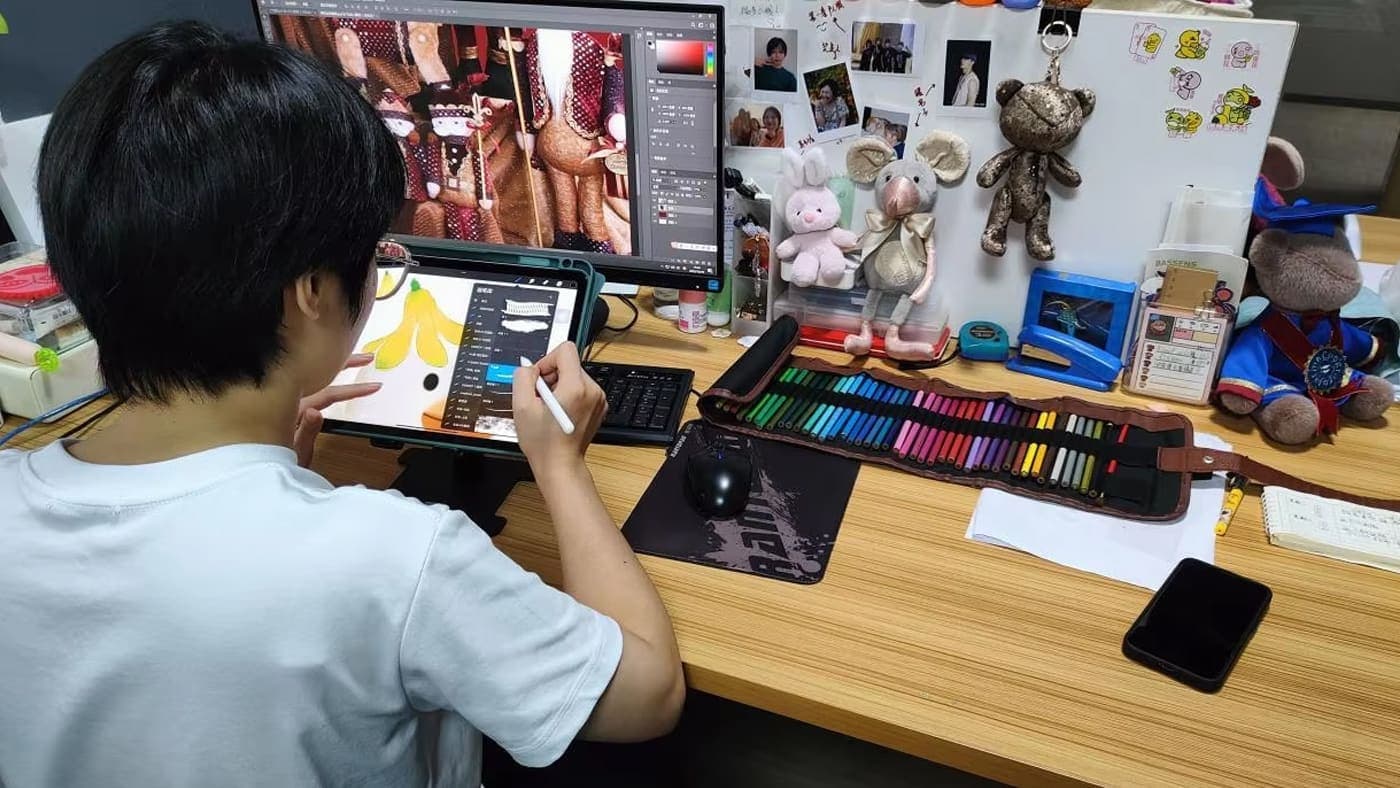
A plush toy starts life as a flat drawing and ends as a rounded, huggable object — and the craft that bridges those two is pattern-making. It's the most invisible and most decisive stage: the same character with a good pattern is charming and with a bad one is lumpy. Here's how a pattern-maker actually turns a sketch into the flat fabric panels that become a 3D toy.
Why a flat sheet can't be a round toy
Here's the intuition no competitor leads with. A flat piece of fabric can curl into a tube or a cone, but it cannot wrap a sphere without stretching, puckering or being cut — the same reason a flat paper map always distorts a round globe. So to build a rounded plush, the form has to be broken into multiple panels and shaped with darts and gussetsthat introduce the curvature flat fabric can't hold on its own. Everything in pattern-making follows from that one geometric fact.
Sketch to sewing panels: the workflow
- 1Three-view drawingFront, side, top — dimensions aligned
- 2Break into panelsHead, body, limbs, ears — where seams fall
- 3Add seam allowance~3–6 mm on plush, on every edge
- 4Darts & gussetsBuild the 3D curvature
- 5Muslin toileSew, stuff, evaluate the shape
- 6Revise & gradeFix, then scale to other sizes
- 7Cutting templatesNotches + pile-direction arrows
Building curvature: darts, gussets & ease
This is the core craft, and it has a precise vocabulary:
| Term | What it is | Role in plush |
|---|---|---|
| Seam allowance | Margin between fabric edge and stitch line | ~3–6 mm on plush (varies with fabric & curve) |
| Dart | A wedge folded out and stitched to a point | Pulls flat fabric into a curve (cheek, snout) |
| Gusset | An extra piece inserted into a seam | Adds 3D volume (a belly or chin gusset) |
| Notch | A match mark on the panel edge | Aligns curved panels like puzzle pieces |
| Grainline / nap arrow | Direction marker on each piece | Keeps pile running the same way |
| Ease | Extra room beyond the literal size | Lets stuffing loft smoothly, not hard |
| Grading | Scaling the pattern to other sizes | Not pure scaling — proportions & seams shift |
A dart removes a wedge to create a shallow cone; a gusset adds a piece to create volume — opposite moves to the same end. And the seam allowance isn't arbitrary: too little and the seam is weak, too much and it bunches inside a tight curve.
The muslin toile: test, stuff, revise
Before anyone cuts real plush, the pattern is sewn up as a cheap muslin toile, lightly stuffed, and judged for silhouette and balance — where does it bunch, where is it flat, does the face read right? Mistakes get marked on the toile and the panels are redrawn. It's the single most valuable step in the whole process and the one that separates a studio from a hobbyist.
Pile direction, notches & cutting templates
Plush fabric has a nap — the fibers lie one way, and stroked against the grain the same fabric looks darker and feels rougher. So every panel must be cut with the pile running the same direction, marked by a nap arrow on each template (this also constrains how pieces nest on the roll, a real fabric-yield cost). Notches — small match marks — let curved panels align correctly when sewn, like puzzle pieces. The finished output is a set of cut-ready templates with seam allowance, notches and nap arrows. The fabrics themselves are in our fabric & materials guide.
Hand vs digital: UV-unwrapping a 3D model
There are two routes to a pattern, and most factories use both. Traditional hand patterning drafts or drapes the panels from the drawing. The digital route uses UV unwrapping — software unfolds a 3D model's surface at chosen seams and lays it flat, which is literally the plush problem solved by computer. Digital is faster to learn and rescale, but it can't predict how stuffing will stretch the fabric or fully capture a character's expression — so the honest reality is a hybrid: draft digitally, then hand-correct after the toile reveals what the algorithm couldn't.
Why good patterning = quality (and safety)
The pattern fixes where every seam falls and how much curve each panel carries — so it sets the toy's whole “face” and shape, and it has real safety consequences too. Panel layout and seam allowance govern seam strength, and the turn-and-stuff opening(the gap the toy is turned and stuffed through) must sit on a low-stress seam and be closed securely so stuffing can't escape — exactly what the seam-strength tests in ASTM F963 / EN 71 check. Good patterning is, quietly, half of quality. See how a design becomes a pattern in the first place in our drawing-to-plush guide and what to hand over in our tech-pack guide.
Get the pattern right
Send us your character and we'll draft and toile the pattern until the silhouette is right — then grade it and cut it clean. Start on our contact page, request a sample, or browse our customer case portfolio.
よくある質問
How is a plush pattern made?
What are darts and gussets?
Can you make a plush from a 3D model?
Why does a plush toy look lumpy or wrong?
Why does pile direction matter when cutting plush?
オリジナルぬいぐるみの製作を始めませんか?
ご計画の内容をお聞かせください。営業時間内であれば1時間以内に工場直送のお見積りをお送りします。