Plush Toy Fabric & Materials Guide: GSM, Pile, Fill, Cost & Compliance
A Shenzhen plush factory's spec-sheet guide to choosing plush fabric and fill — minky, velboa, faux fur, organic cotton, RPET, PP-cotton, kapok — with GSM, pile, denier, FOB cost tiers and a use-case decision tree.

Pick the wrong fabric and your plush will pill in three weeks, your minky will tunnel after the first wash, or your eco-friendly RPET will fail OEKO-TEX 100 because of the dye lot you didn't check. This guide is the same spec table our materials team uses on the costing floor — GSM, pile height, denier, fill density, compliance, and a use-case decision tree mapped to FOB cost bands. It's everything we wish a first-time plush buyer brought to the first call.
How to read a plush fabric spec sheet
Every fabric quote from a Chinese mill comes with three numbers. Learn what they mean and you'll be able to compare quotes from different suppliers like-for-like instead of guessing.
- GSM (grams per square metre): weight per unit area. Lightweight microfleece is 180–250 GSM, mid-weight short plush 250–320 GSM, dense sherpa 300–450 GSM. Higher GSM = denser hand-feel and usually higher cost.
- Pile height (mm): how long the fibres stand off the backing. Velboa 1.5–2.5 mm, mochi minky ~1 mm, standard minky 3–5 mm, mid-pile 3–6 mm, faux fur 6–60 mm.
- Denier (D): linear mass density of a single fibre — 1D = 1 g per 9,000 m of fibre. Lower denier (sub-1D "microfibre") feels silkier; higher denier (3D+) feels coarser but is more durable. PP-cotton fill is usually specified as 7D or 15D hollow-conjugated polyester staple fibre.
- Backing type: tricot knit (most common, low shed), woven (premium, used for shaggy/long-pile), and bonded (cheap, avoids for kids' toys — backing flakes inside the seam).
If your end market includes infant or toddler product, also ask for the certificate class. OEKO-TEX Standard 100 Product Class I (for items in contact with babies) caps formaldehyde at 16 mg/kg and pH between 4.0–7.5 — a tighter spec than the Class II most adult-target plush is tested against.
Outer-fabric matrix — what each fabric is actually good for
Twelve fabrics cover roughly 95% of the custom plush we run at StarDream Toys. The table below pairs each fabric with its typical GSM range, pile height, FOB cost tier ("$" = under $4/m, "$$" = $4–$8/m, "$$$" = $8+/m at our standard mill volumes), and the use case it actually fits.
| Fabric | GSM | Pile (mm) | Cost | Hand-feel | Best use |
|---|---|---|---|---|---|
| Short plush / velboa | 180–250 | 1.5–2.5 | $ | Smooth, low shed | Keychain, infant 0–3, retail figurine |
| Mochi minky | 200–260 | ~1 | $$ | Dense, marshmallow | Premium gift, sensory plush |
| Standard minky | 260–320 | 3–5 | $$ | Plush, soft drape | Mid-size mascot, kids' favourite |
| Mid-pile plush | 280–340 | 3–6 | $$ | Lush, well-rounded | Character body, retail toy |
| Corduroy plush | 240–300 | 2–4 (ribbed) | $$ | Textured, vintage feel | Boutique gift, designer plush |
| Sherpa / boa | 300–450 | 5–8 | $$ | Cosy, wool-like | Winter line, oversized lounger |
| Long-pile plush | 300–380 | 8–15 | $$$ | Shaggy, hugs back | Statement plush, photo prop |
| Faux fur (woven) | 400–550 | 15–40 | $$$ | Realistic animal coat | Lifelike animal plush, premium IP |
| Boa shaggy | 350–450 | 30–60 | $$$ | Wild, dramatic | Costume mascot, props |
| Velour | 220–280 | <1 | $$ | Silk-smooth | Soft-touch body, lining |
| Organic cotton terry | 300–400 | 2–3 (loop) | $$$ | Natural, hypoallergenic | Eco line, infant-target |
| RPET plush (recycled) | 240–320 | 2–4 | $$ | Indistinguishable from poly | Sustainability story SKUs |
Cost tiers are at standard 1,000-m mill MOQ. Custom Pantone dye-lot adds 8–15% on top of the base cost.
Fill materials — what's inside the plush
Fill choice is half the perceived quality of a plush. Two products with identical outer fabric feel completely different depending on whether the inside is PP-cotton, recycled PET, kapok, or a weighted blend. The table below covers the six fills we use most.
| Fill material | Density (g/L) | Firmness | Age-safe | Notes |
|---|---|---|---|---|
| PP cotton (7D hollow-conjugated) | 25–35 | Plush, springs back | All ages | Industry default. Light, low cost, washable. Holds shape well. |
| PP cotton (15D hollow-conjugated) | 35–50 | Firmer, more body | All ages | Used for character body / heavier hug-feel. Slightly higher cost. |
| RPET fibre fill (recycled PET) | 25–40 | Identical to PP cotton | All ages | GRS-certified options available. ~5–10% cost premium. |
| Cotton fibre (natural) | 30–50 | Dense, less spring | All ages (organic preferred) | Heavier. Compacts over time. Compostable end-of-life. |
| Poly pellets / glass beads | — | Weighted, settled | 3+ only (choking) | Used for weighted plush, lap pads, sensory plush. Must be sewn into inner pouch. |
| Organic kapok | 20–30 | Light, lofty | All ages (hypoallergenic) | Premium eco line. Costly, low MOQ availability. |
Pro tip: when you spec a plush, always state the fill ratio (e.g. "belly 70% loft, head 90% loft, limbs 50% loft") rather than "firm" or "soft." Numbers translate; adjectives don't.
Use-case decision tree — pick the spec by purpose
Fabric + fill choice is downstream of who's holding the plush. Below is the decision tree our materials team walks new clients through.
- 1Who holds it?Infant / kid / adult / collector
- 2What size?Keychain / mid / giant
- 3Indoor or outdoor?Retail / event / outdoor
- 4Wash frequency?Daily / weekly / display only
- 5Eco priority?Standard / RPET / organic
| Use case | Outer fabric | Fill |
|---|---|---|
| Infant 0–3, retail toy | Short plush velboa, OEKO-TEX I | 7D PP cotton, no pellets |
| Plush keychain (under 12 cm) | Short plush / velboa, low GSM | 7D PP cotton, light loft |
| Mid-size kids' plush (20–30 cm) | Standard minky or mid-pile | 15D PP cotton, even loft |
| Giant plush (60 cm+) | Long-pile plush or sherpa | 15D PP cotton + structural foam core |
| Mascot for trade-show giveaway | Mid-pile plush, embroidery-friendly | 15D PP cotton, firm body |
| Weighted / sensory plush (3+) | Mid-pile or minky | Glass micro-beads in inner pouch + PP cotton outer |
| Eco / sustainability SKU | RPET plush or organic cotton terry | RPET fibre fill or organic kapok |
| Premium IP / collectible (adult) | Mochi minky or faux fur | 15D PP cotton, sculpted firmness |
Compliance — which materials pass which standard
Material choice and compliance are tightly linked. A wrong dye lot can fail EN 71-3 even if the same fabric passed last quarter. A wrong fill can fail CPSIA's small-parts rule. Build the test plan from the bill of materials, not the other way around.
Three standards cover the vast majority of plush markets. U.S. CPSIA (Consumer Product Safety Improvement Act) regulates lead, phthalates, and small parts; EN 71 (European toy safety) covers mechanical/physical (Part 1), flammability (Part 2), and migration of certain elements (Part 3); ASTM F963 is the U.S. parallel and overlaps heavily with EN 71. RPET fabrics that claim recycled content additionally need GRS (Global Recycled Standard) chain-of-custody documentation. Organic cotton needs GOTS.
Cost & MOQ reality — what dictates fabric pricing
Fabric pricing has three drivers most buyers don't see: (1) mill dye-lot MOQ — typically 300–500 m per Pantone, below which the mill rejects the order or charges a setup; (2) fibre futures — RPET and organic cotton track commodity indices independent of the plush market; (3) season — September–November sees a 5–10% mill price bump as everyone gears up for Christmas-launch sample runs.
Practical takeaway: lock fabric pricing at the tech-pack stage with a written quote from your factory that names the mill and the colour code. Verbal "around $X per metre" quotes float.
How to request a fabric sample (the exact language to send)
Send your factory a request that includes these six items. You'll save 3–5 days of back-and-forth.
- Fabric category and Pantone (e.g. "260 GSM short plush, Pantone 17-1463 Tangerine Tango").
- Pile height in mm, not adjectives.
- Backing type (tricot knit preferred for kids' toys).
- OEKO-TEX product class required (Class I for infant; Class II for adult).
- Fill spec including denier and density (e.g. "15D hollow-conjugated, 40 g/L body, 30 g/L limbs").
- Target end market — drives the test plan (EN 71, ASTM F963, CPSIA, REACH, GRS, GOTS, OEKO-TEX).
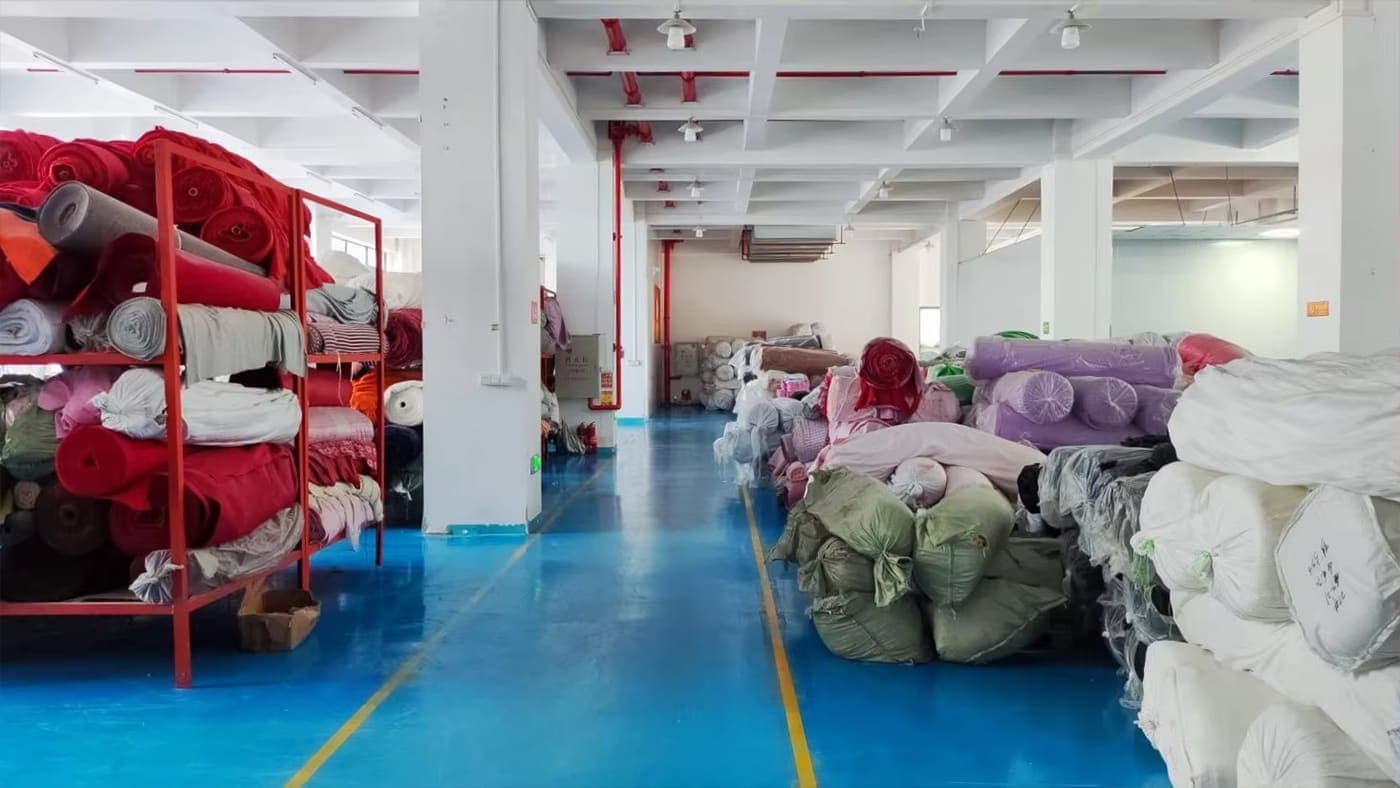
Inside our materials room
A short walk-through of our materials and sampling room — every plush program starts here before a single panel is cut on the production floor.
By the numbers
Putting it all together
Start with the end user and work backwards. Toddler? OEKO-TEX I, short plush, 7D fill, no pellets. Adult collector? Mochi minky or faux fur, 15D sculpted fill. Eco-priority brand? RPET or organic cotton + GRS/GOTS paperwork. Once the spec is locked, every downstream cost — sample fee, MOQ, lead time, test panel — falls into a predictable range.
When you're ready to spec a program, you can send your tech pack to our materials team, or browse our customer case gallery to see how these material choices play out across real client orders.