Contrôle qualité des peluches & inspection avant expédition AQL : guide acheteur
Comment fonctionne vraiment le QC peluche : échantillonnage AQL avec une vraie table de taille d'échantillon, défauts critiques/majeurs/mineurs avec exemples peluche, tests de traction/couture/aiguille, le flux IPC-DUPRO-PSI-CLC et les coûts d'inspection tierce.

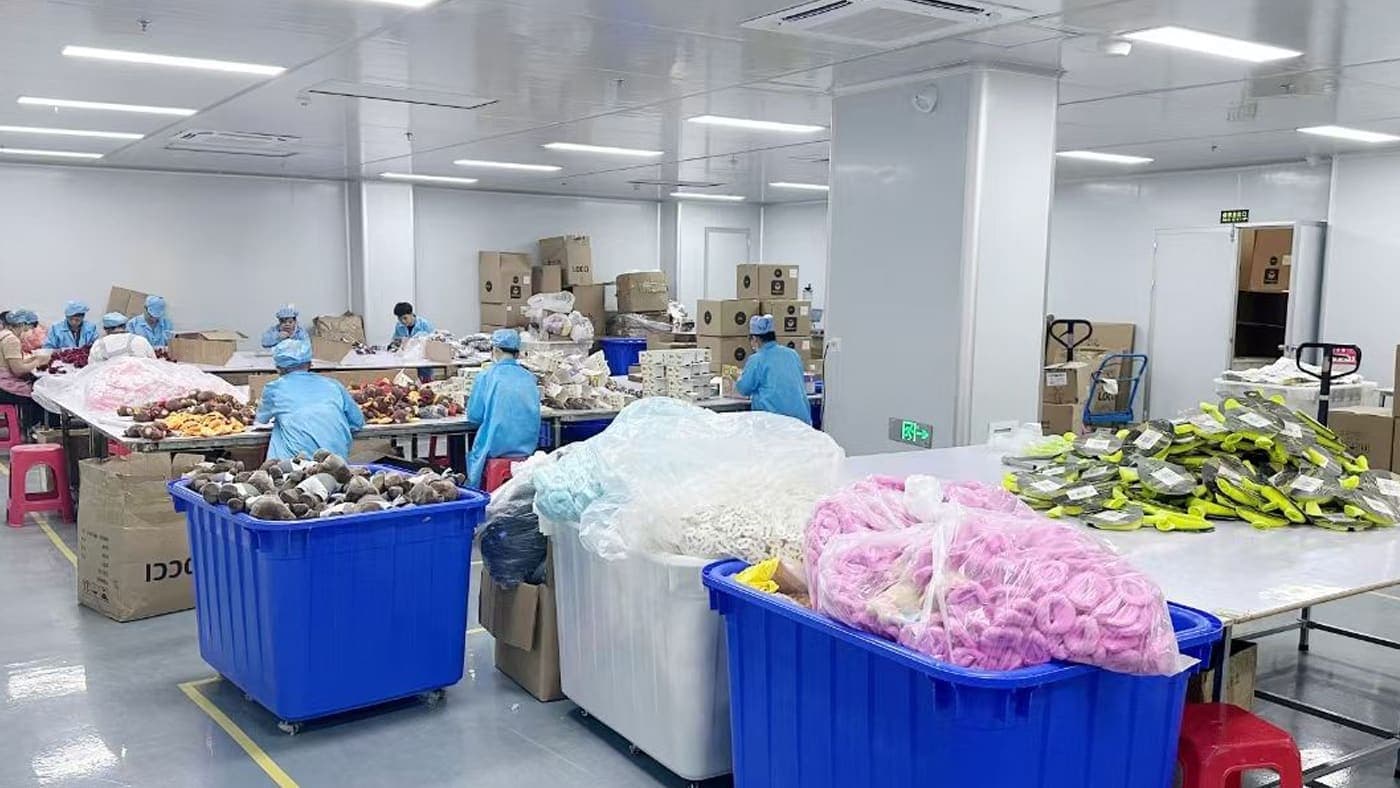
Quality control is the difference between a plush order that lands on shelves and one that lands in returns — or a recall. Most QC articles are written by inspection vendors selling a service, or are generic AQL primers with no plush in them. This one is written from the factory floor: the real AQL mechanics with a usable sample-size table, the defects that matter for stuffed toys, the physical tests we run, and where in the production timeline each check happens.
Where inspections happen
QC isn't one event at the end — it's a series of gates across the run, and the cost of fixing a defect rises the later you catch it. Four checkpoints matter:
- IPC — Initial Production Check. At the start: raw materials, components and the approved sample are verified before the line ramps.
- DUPRO — During-Production Inspection. At roughly 10–80% complete: first units off the line are checked so systemic defects are caught while there's still time to fix the run.
- PSI — Pre-Shipment Inspection (Final Random Inspection). At 80–100% complete and at least ~80% packed: this is where AQL sampling is formally applied.
- CLC — Container Loading Check. At shipment: quantity, carton condition and correct stowage into the container.
- 1IPC0% — materials, components, approved sample
- 2DUPRO10–80% — first units, in-line workmanship
- 3PSI / FRI80–100% packed — AQL sampling applied
- 4CLCLoading — quantity, carton, stowage
- 5ShipLot released
AQL without the headache
AQL — Acceptable Quality Limit— is the maximum percent defective treated as acceptable for a lot. It's defined internationally by ISO 2859-1 and in the US by ANSI/ASQ Z1.4 (the commercial successor to MIL-STD-105E). Instead of inspecting every piece, you inspect a statistically chosen sample and accept or reject the whole lot based on how many defects you find. General Inspection Level II is the default balance of rigor and cost. The common AQL set for toys is Critical 0, Major 2.5, Minor 4.0 — tighten Major to 1.5 for infant or premium lines.
From lot size to sample size
Sample size is a function of lot size, not a flat percentage. You look up a code letter from the lot size and inspection level, then read the sample size and accept/reject (Ac/Re) numbers for your chosen AQL. Here is the slice of the General Inspection Level II table that covers most plush orders:
| Lot size | Code | Sample size | AQL 2.5 (Ac / Re) | AQL 4.0 (Ac / Re) |
|---|---|---|---|---|
| 151–280 | G | 32 | 2 / 3 | 3 / 4 |
| 281–500 | H | 50 | 3 / 4 | 5 / 6 |
| 501–1,200 | J | 80 | 5 / 6 | 7 / 8 |
| 1,201–3,200 | K | 125 | 7 / 8 | 10 / 11 |
| 3,201–10,000 | L | 200 | 10 / 11 | 14 / 15 |
Worked example: a 4,000-piece plush order falls in the 3,201–10,000 band → code letter L → inspect 200 units drawn at random across the cartons. At AQL 2.5 you accept the lot on 10 or fewer Major defects and reject on 11 or more. Critical defects sit at AQL 0 — a single one fails the lot.
Defect classification for plush
The AQL numbers only mean something once defects are sorted into the right severity. Here's how it maps to real stuffed-toy problems:
| Level | Default AQL | What it means | Plush examples |
|---|---|---|---|
| Critical | 0 | Safety hazard / regulatory violation | Loose or detached safety eye or nose; exposed or broken needle; seam burst releasing stuffing; accessible small part on an under-3 toy; missing or non-compliant warning label |
| Major | 2.5 | Reduces usability or saleability | Weak seam failing the pull test; uneven or insufficient stuffing; staining; strong chemical odour; size out of tolerance; dead sound chip |
| Minor | 4.0 | Cosmetic, no effect on function or safety | Loose threads or fraying; embroidery or print misalignment; slight colour-shade variation; small dirty marks |
The plush-specific tests we run (and you should demand)
- Pull / tension test on eyes, noses, limbs, tails and accessories. EN 71-1 applies 50 N for parts up to 6 mm and 90 N for larger parts (over 5 seconds, held 10); ASTM F963 applies about 10 lbf for ages 0–18 months and 15 lbf for older. A rotatable part gets a torque test first.
- Seam strength / use-and-abuse test — seams must survive abuse without releasing stuffing or an accessible small part.
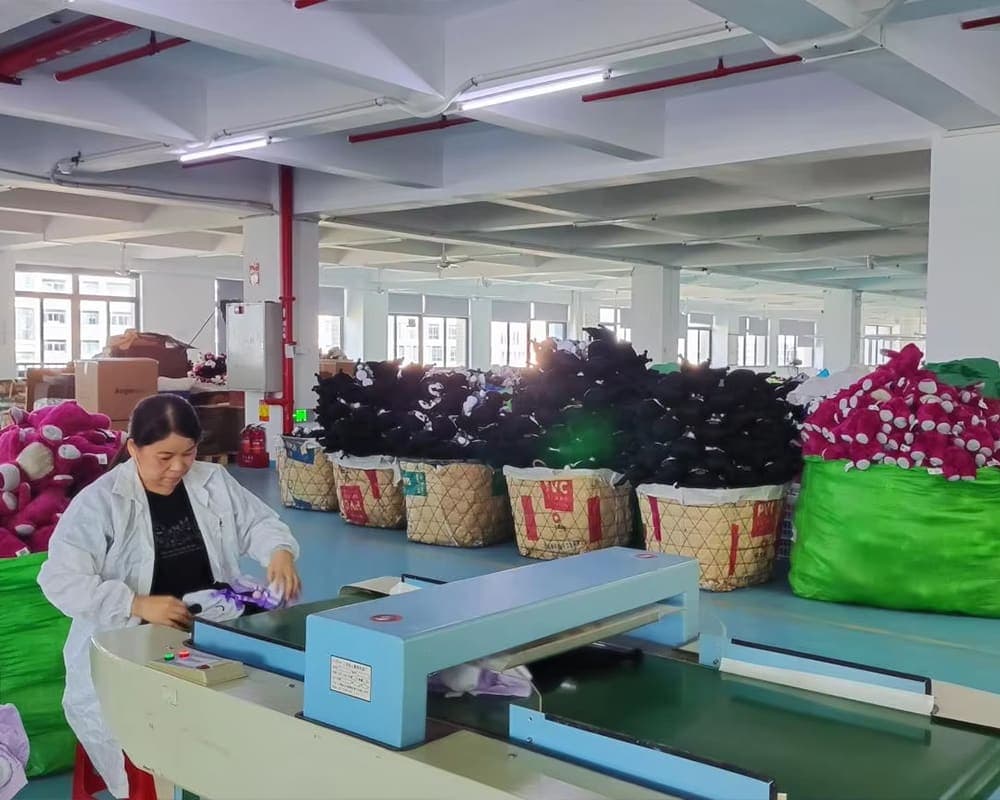
- Needle & metal detection — every unit through a calibrated detector before packing; a detected needle is a critical defect.
- Fill weight & stuffing density — weighed against the approved sample; checked for lumps and hollow limbs.
- Dimensional tolerance — measured against the tech-pack spec.
- Colour vs approved sample, odour and cleanliness checks.
- Labels, warnings, age grading, tracking label & barcode scan.
- Function tests (sound chips, rattles, lights) and a carton drop test on shippers.
Safety standards your plush must meet
QC checks workmanship; safety standards check the product against law. ASTM F963-23 (mandatory in the US), EN 71 parts 1/2/3 (mechanical, flammability, chemical migration) for the EU, CPSIA (lead, phthalates, tracking labels, third-party testing) for US-bound children's products, REACH for the EU, and GB 6675 for China. A plush program shipping to multiple markets must clear all the relevant ones. The full breakdown is in our plush safety standards guide.
Third-party inspectors & cost
The major independent inspectors — QIMA, SGS, Bureau Veritas, Intertek, TÜV — provide an extra layer of assurance and an impartial record if a dispute arises. In China, budget roughly US$280–320 per man-day(QIMA from about $309); a standard plush pre-shipment inspection is usually one man-day. Even when a factory's in-house QC is strong, many buyers run third-party PSI on first orders and high-value runs, then move to spot checks once trust is established.
QC built into every order
At StarDream Toys, in-line QC, our own needle/metal detectors and AQL-based pre-shipment inspection are part of every program, and we welcome your third-party inspector on site. Send your spec and your AQL preferences via our contact page, see real shipped orders in our customer case portfolio, or learn how we hit deadlines without cutting QC in our 30-day manufacturing timeline.