Plush Toy Eyes, Noses & Features: Safety Eyes vs Embroidered vs Glass
How plush eyes and noses are made and attached — embroidered, plastic safety eyes, glass — why 'safety eyes' aren't safe for babies, the pull test, and how to choose by age.

The fastest way to get a plush failed at lab testing isn't the fabric — it's the eyes. The feature choice quietly decides the toy's whole age grade, and one of the most dangerous misunderstandings in the trade is the name “safety eye.” This is the honest, factory-side guide to how eyes and noses are made, which is safe for whom, and why a baby's plush must be embroidered.
The feature decides the age grade
On a plush, the eyes and nose are the components most likely to detach — so they're the components toy-safety law cares about most. Get them right and the toy can be graded for any age; get them wrong and it's either a recall risk or restricted to older children. The rule of thumb: the age grade dictates the feature, not the other way around.
The ways eyes & noses are made
| Type | How it attaches | Look | Age suitability |
|---|---|---|---|
| Embroidered | Stitched into the face — no separate part | Soft, flat, matte | All ages incl. under-3 |
| Plastic safety eye | Ridged post + locking washer | Glossy, 3D, lively | 3+ (if pull-test passed) |
| Sew-in shank eye / button | Stitched through a loop | Classic, raised | 3+ (small part) |
| Glass eye | Wire loop / shank, wired in | Most realistic depth | Collector / adult only |
| Felt / appliqué | Sewn fabric shape | Soft, graphic | All ages if securely stitched |
| Printed / painted | Applied to the fabric | Flat, detailed | All ages (ink must be tested) |
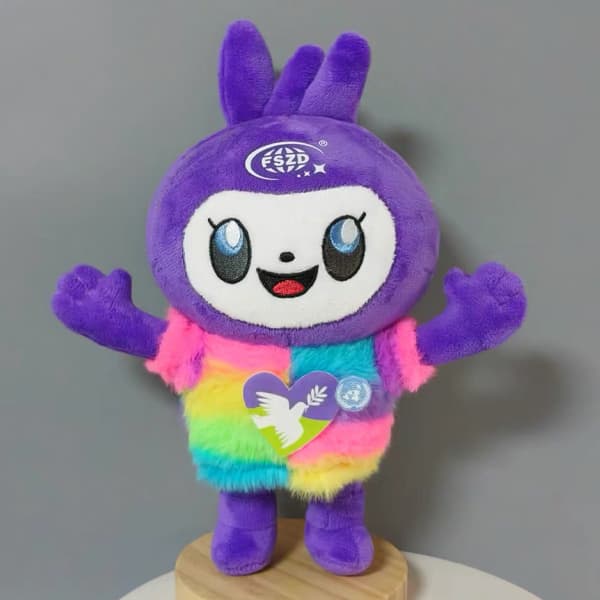
How “safety eyes” work — and the catch
A plastic safety eyeis a molded eye with a ridged post on the back. The post is pushed through the fabric and a barbed washer is pressed on from behind; the barbs ratchet over the ridges and lock, so the eye is effectively impossible to pull off by hand. That's what “safety” means here — a secure attachment versus a loose glued-on eye. But here's the catch that matters: the eye-and-washer assembly won't separate, yet it's still a rigid small part, and a baby can chew through the surrounding fabricand free the whole thing. So a “safety eye” is fine for ages 3+, and never the right choice for under-3.
Glass eyes: realism, but not for kids
Glass eyes — mounted on a wire loop or shank — give the most realistic depth and catch-light, which is why they define premium collector and display bears. They're also fragile and a clear choking hazard, so they're strictly for an adult audience, never a children's toy. (Historically, glass eyes were used on early teddy bears before the 1950s plastic stem-and-washer eye made kids' toys safer.)
The pull test & small-parts rule
How a lab decides whether a feature is secure enough — and whether it's a choking hazard at all:
| Test | What it does | The rule |
|---|---|---|
| EN 71-1 tension test | Pulls attached parts (~90 N for parts >6 mm; 50 N if ≤6 mm, ~10 s) | Must not detach |
| ASTM F963 use-and-abuse | Tension & torque after simulated wear | Equivalent — must not detach |
| Small-parts cylinder (16 CFR 1501) | Does the part fit a ~2.25 × 1.25 in cylinder? | If yes → banned in under-3 toys |
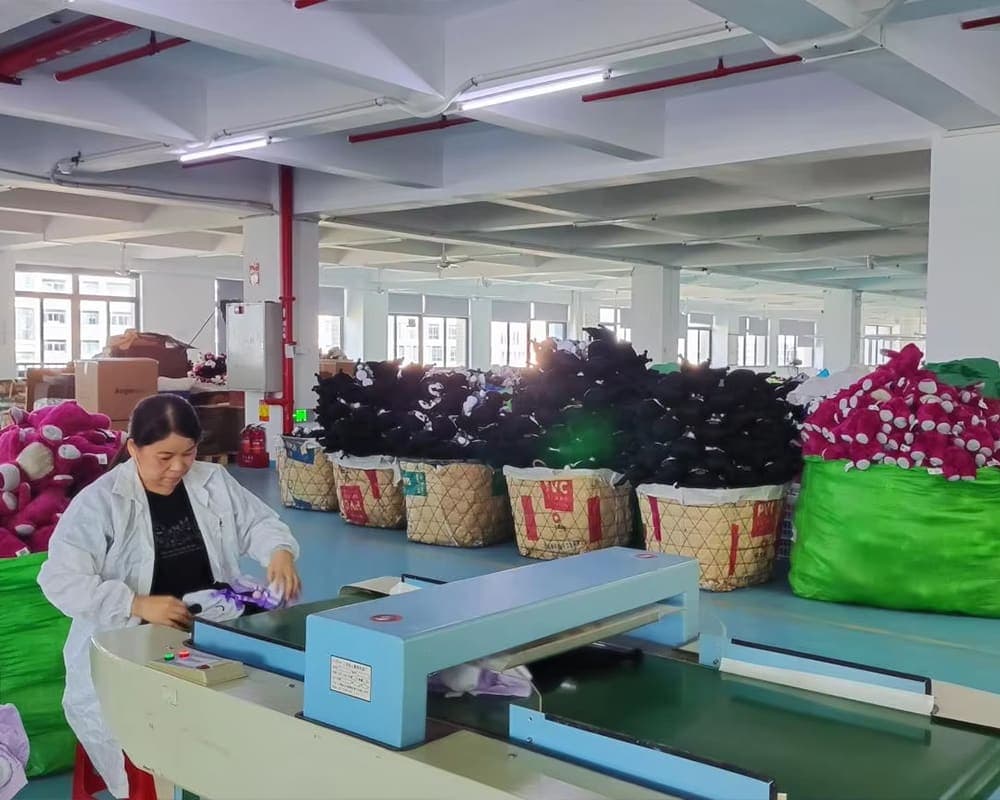
The decisive point for babies: for an under-3 toy, a detachable feature isn't allowed at all— passing a pull test isn't enough, because the failure mode is the fabric tearing, not the washer releasing. That's the whole case for embroidery. We pull-test on the line and hold third-party EN 71-1 and ASTM F963 / EN 71 reports; the small-parts rule itself lives in 16 CFR Part 1501.
Choosing features by age
Start from the age grade and the market, then the feature follows:
- 1Under 3 / babiesEmbroidered features only — no detachable part
- 2Ages 3+Safety eyes OK if pull-test passed
- 3Collector / adultGlass eyes for realism
- 4Any age, flat lookPrinted / appliqué (ink tested)
- 5Then: pull-test & certifyEN 71-1 / ASTM F963 reports
It connects to the wider under-3 picture in our baby-safe plush guide and the full testing regime in our safety standards guide.
Spec your plush's features
Tell us the age grade and market and we'll spec compliant eyes and noses — embroidered for babies, pull-tested safety eyes for older kids — and supply the test reports. Start on our contact page, request a sample, or read our decoration methods guide for faces overall.
よくある質問
Are safety eyes safe for babies?
How are plush eyes attached?
What's the difference between safety eyes and glass eyes?
Why are baby plush eyes embroidered?
Do plush eyes have to pass a pull test?
オリジナルぬいぐるみの製作を始めませんか?
ご計画の内容をお聞かせください。営業時間内であれば1時間以内に工場直送のお見積りをお送りします。