Baby & Infant-Safe Plush: Manufacturing for the Strictest Safety Tier (0–3)
Cuddly plush defaults to the under-3 tier, so every baby plush starts at maximum strictness: no small parts at all, reinforced seams, safe washable fabrics and full chemical compliance.

Here's the fact that should govern every decision in a baby plush program, and that almost no competitor leads with: a cuddly, soft-filled toy is treated as suitable for a child under three by default— so it starts at the strictest safety tier there is. That single default rewrites the whole design: no small parts at all, seams that can't be opened, fabrics a baby can mouth and you can wash. This is the compliance-desk guide to getting it right.
Why baby plush is the hardest toy to make safely
A baby plush has to defend against four different failure modes at once: choking (a part coming loose), aspiration (inhaling fibers), strangulation (cords and loops), and chemical exposure(everything ends up in the mouth). Because the toy defaults to the under-3 tier, there's no “we'll add a warning label” escape hatch — the hazard has to be designed out, not disclosed.
The absolute rule: no small parts for under-3s
Under 16 CFR Part 1501, any component that fits entirely inside a standardized small-parts test cylinder — roughly 1.25 in (31.7 mm) wide by 2.25 in (57.1 mm) deep, modeling a young child's throat — is a small part. For a toy intended for under-3s it's banned outright: unlike a toy for ages 3+, you can't keep it and add a choking-hazard warning. And during use-and-abuse testing, any part that detaches and fits the cylinder also fails — except fabric, yarn and string. That single exemption is why the entire face has to be stitched, not stuck on:
| Banned for under-3 (small part) | Compliant replacement |
|---|---|
| Plastic 'safety' eyes | Embroidered eyes |
| Plastic nose | Embroidered or fabric-appliquéd nose |
| Buttons / beads | Appliquéd fabric shapes |
| Bells / hard rattles loose in the body | Fully sealed crinkle / enclosed sound unit |
| Sequins, googly eyes | Printed or embroidered detail |
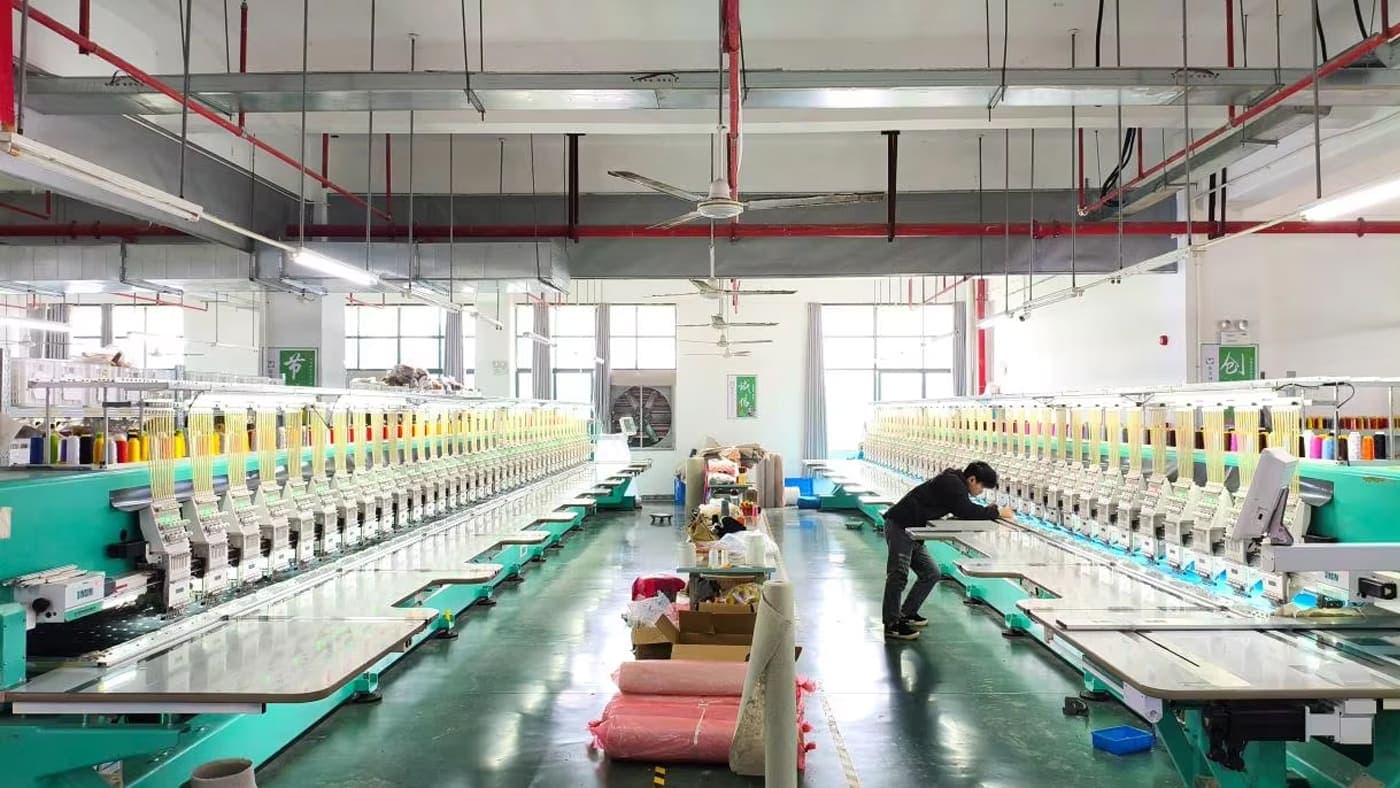
Built to hold together: seams & fill
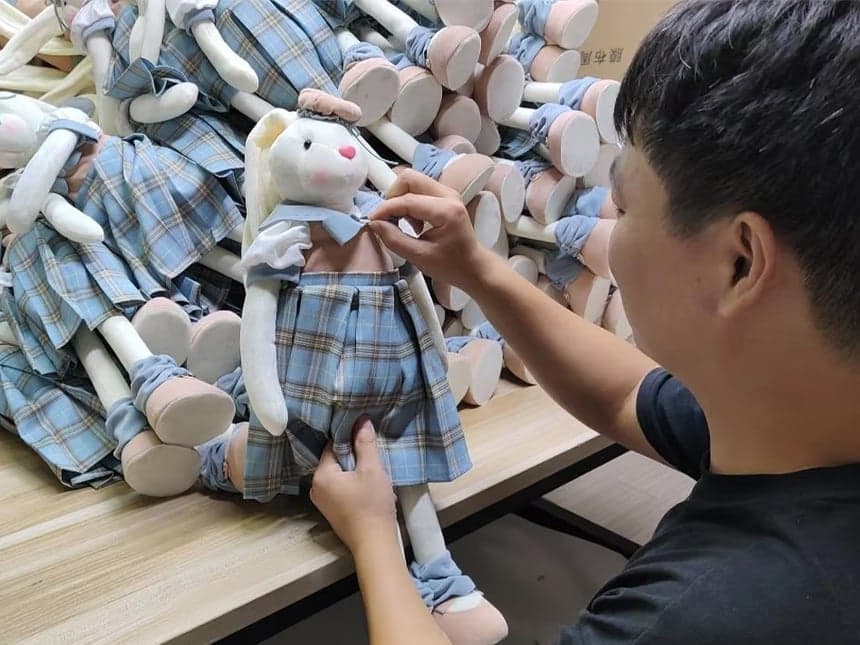
A baby plush fails dangerously if a seam opens and the stuffing comes out. So seam integrity is engineered and tested:
- Seam-strength rule— EN 71-1 requires that a child can't get two fingers through a seam to pull out clumps of filling; seams are double-locked stitched to that target.
- Pull / tension testing — components on under-3 toys are pulled with about 90 Nto confirm nothing detaches.
- Clean, new fill — virgin fiber, never recycled rags, with needle / metal detection on every unit.
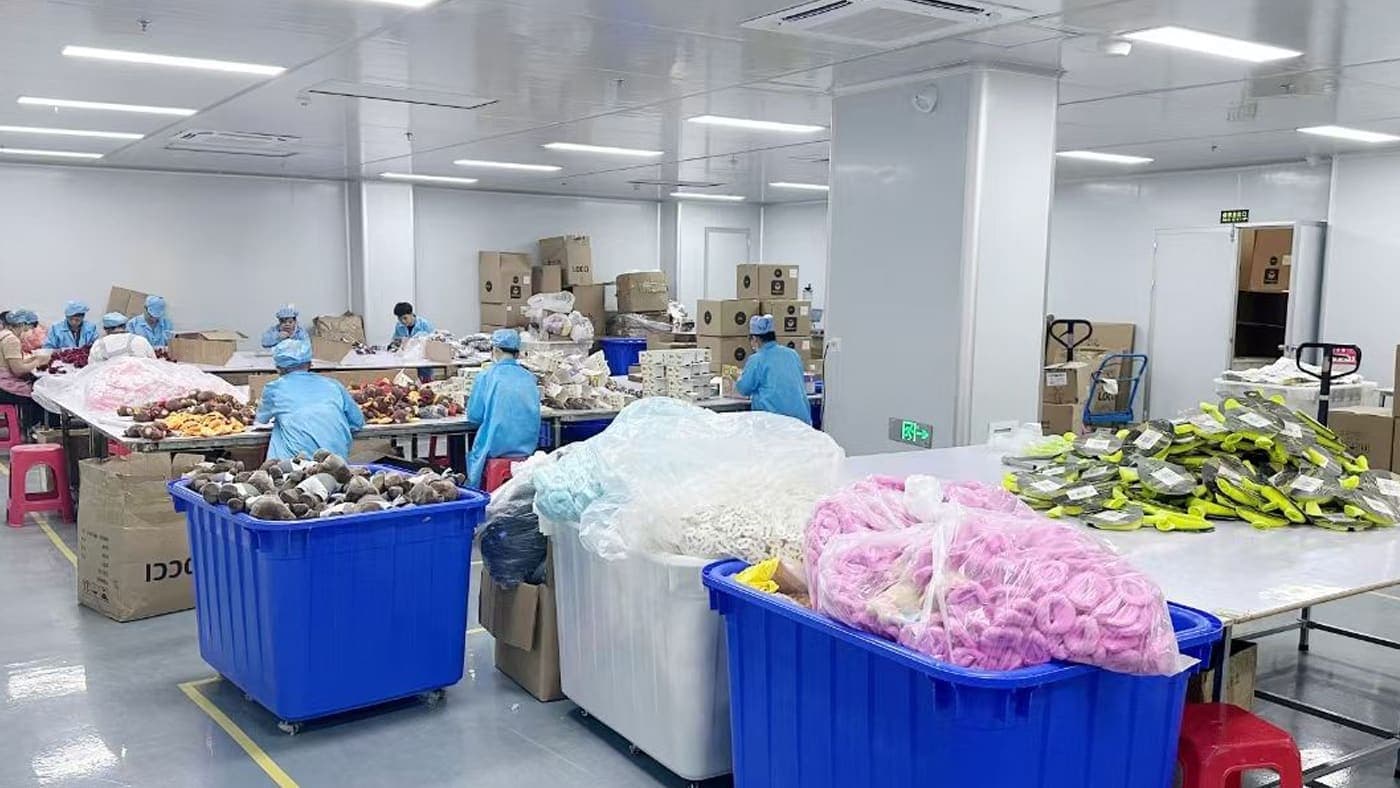
Soft, clean, washable fabrics for infant skin
Three material rules matter for babies specifically. Use low / short-pile fabrics(short-pile minky, velour, terry) so loose fibers can't be inhaled — long shaggy fur is the wrong choice for an infant. Build for machine-washability, which is a safety property here, not a convenience: drool and bacteria make repeated gentle washing essential, so seams, dyes and construction must survive it. And consider organic cotton with GOTS and OEKO-TEX STANDARD 100 (which has a stricter class for items for babies) — voluntary certifications that add material trust on top of the mandatory standards, not instead of them. More in our fabric & materials guide.
The standards you must hit: US & EU
Baby plush is bound by mandatory toy law on both sides of the Atlantic:
| Requirement | Under-3 (baby plush) | Ages 3+ |
|---|---|---|
| Small parts | Banned — must be removed/redesigned | Allowed with a choking-hazard warning |
| Seam / pull testing | Required (no access to filling) | Required |
| Chemical limits | Full CPSIA / EN 71-3 | Full CPSIA / EN 71-3 |
| Default for cuddly plush | Yes — the strictest tier applies | Only if clearly designed to exclude infants |
In the US, ASTM F963-23 is mandatory under the CPSIA, with lead capped at 90 ppm in coatings (100 ppm in substrate), regulated phthalates at 0.1%, third-party lab testing, a Children's Product Certificate and a tracking label. In the EU, EN 71 and CE marking apply under the Toy Safety Directive 2009/48/EC — soon replaced by the new Toy Safety Regulation (EU) 2025/2509, which applies from 1 August 2030 and adds a digital product passport. The wider picture is in our safety standards guide, and how it's verified in our QC & AQL guide.
- 1Default to the under-3 tierCuddly plush = strictest by default
- 2No detachable partsEmbroider/appliqué every feature
- 3Reinforce seamsNo access to filling · ~90 N pull test
- 4Low-pile, clean fillNo inhalable fibers · needle detection
- 5Chemical complianceLead/phthalate limits · EN 71-3
- 6Third-party test + CPCAccredited lab · tracking label / CE
Rattles, crinkle & teethers without the risk
Developmental features are great for babies — they just add rules. Teethers are mouthed by design, so they need food-contact-grade, BPA-, PVC- and phthalate-free materials (food-grade silicone) and must meet ASTM F963 and EN 71-9 for mouthed parts. Rattlesmust comply with 16 CFR Part 1510 so they can't lodge in an airway. Crinkle and sound elements are fully sealed inside the plush so a child can never extract them. And the simplest rule of all: no free cords or long ribbons on baby plush — strangulation risk. EN 71-derived design limits keep free cords short (around 22 cm) and loops small (around 38 cm), but on infant plush the safest choice is to omit free cords entirely.
Labeling, care & proof of compliance
The last tier is documentation. Baby plush needs correct age grading, a permanent tracking label and a Children's Product Certificate (US) or CE marking and declaration of conformity (EU), plus a sewn-in care label with washing symbols. Demand from your factory the per-batch test reports behind those marks — a certificate without a current lab report is just a sticker.
Make baby plush the right way
Send us your concept and target markets and we'll design it to the under-3 tier from the first sketch — embroidered features, tested seams, safe washable fabrics — and certify it to ASTM F963 / EN 71 with the reports to prove it. Start on our contact page, request a sample, or browse our customer case portfolio.
よくある質問
Are plastic safety eyes allowed on baby plush toys?
What age tier do plush toys fall under by default?
How do regulators decide if a part is a 'choking hazard'?
Can a baby plush toy include a teether or rattle?
What chemical and material standards must baby plush meet?
オリジナルぬいぐるみの製作を始めませんか?
ご計画の内容をお聞かせください。営業時間内であれば1時間以内に工場直送のお見積りをお送りします。