Best Custom Plush Toy Factories in China — 2026 Buyer's Guide
How to evaluate custom plush toy factories in China for 2026 — verification checklist, regional differences (Shenzhen / Yiwu / Dongguan), pricing benchmarks, red flags.

“Best” depends on what you're buying. A buyer evaluating factories for a 25,000-pc giveaway plush needs different things from one launching a licensed-IP retail SKU. This guide gives you the evaluation framework — verification checklist, regional differences, audit tiers, pricing benchmarks — so you can build a defensible shortlist instead of guessing from Alibaba listings.
Transparency note
We are StarDream Toys, a Shenzhen-based plush factory operating since 2008. We're writing this guide and we're listing ourselves as a candidate. We try to be honest about where we win and where another factory beats us — see the comparison sections — but you should weight our self-recommendation accordingly.
The actually useful contribution of this article isn't our self-rec; it's the criteria below. Use them to evaluate us, our competitors, and anyone else on your shortlist.
The 7 evaluation criteria that matter
- Audit status. BSCI (labour conditions) and ISO 9001 (quality management) are the minimum baseline in 2026. A factory missing either should not be on your shortlist.
- Manufacturing licence scope.The Chinese business licence has explicit scope categories. Manufacturing (制造 / 生产) ≠ trading (贸易). Verify the scope yourself; don't take the supplier's word.
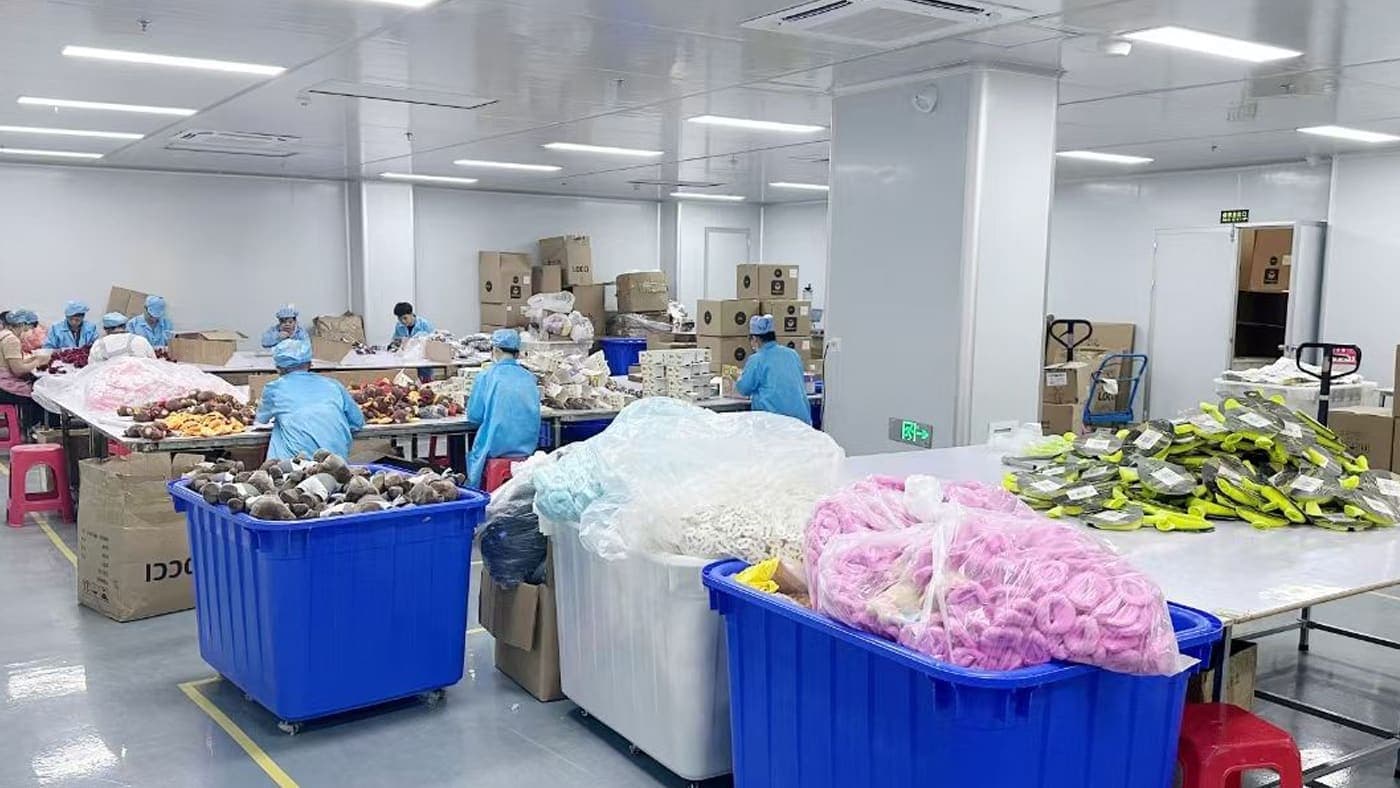
- In-house capability vs sub-contracting. Real factories own their cutting / sewing / stuffing / embroidery lines. Sub-contracting any of these to other factories is a yellow flag (quality variance, IP risk, schedule unreliability).
- Sample turnaround speed.A real factory can sample in 5–7 days standard, 3 days express. If sample time is 10+ days for simple plush, you're likely talking to a broker queuing your design behind their other clients.
- Specialist accessory ecosystem. Does the factory have in-house digitising (embroidery), or do they sub-contract it? Same question for sound chips, LEDs, magnets, custom packaging. Each sub-contract adds 5–15 days and an IP leak point.
- QC process documentation.Ask: how many QC stages? At which points (pre-production, mid-line, pre-shipment)? Is the inspection 100% or AQL-sampled? What's the defect-rate guarantee? Good factories have documented answers; thin ones improvise.
- Buyer references.Ask for 3 references they've produced for. Call them. The conversation is more revealing than any audit document.
Shenzhen vs Yiwu vs Dongguan — regional differences
Three main Chinese clusters produce plush at scale. Each has a different sweet spot:
| Cluster | Best for | Strength | Weakness |
|---|---|---|---|
| Shenzhen (Guangdong) | Custom OEM, licensed IP, accessory-heavy designs | Deepest specialist supplier base (sound, LED, magnets), proximity to Shenzhen / Yantian export ports | Higher labour cost than Yiwu by ~15-20% |
| Dongguan (Guangdong) | Mid-volume custom plush, balance of cost and capability | Same supplier ecosystem as Shenzhen, slightly lower labour cost | Smaller pool of audited factories vs Shenzhen |
| Yiwu (Zhejiang) | Low-cost stock-design ODM, high-volume promotional plush | Cheapest labour, largest fabric supply hub in China | Limited custom OEM capability; most factories are ODM-only; further from major export ports |
| Other clusters (Wenzhou, Qingdao) | Niche specialisations (Qingdao for export-grade hospital plush, Wenzhou for promotional) | Specific niche expertise | Smaller scale, harder to verify |
For first-time buyers we recommend Shenzhen — the supplier ecosystem is the deepest, the audited-factory pool is the largest, and the export logistics are mature. Yiwu is a strong second choice if your spec is simple and your volume is large enough to amortise the higher freight cost to port.
8 red flags that signal a trading company posing as a factory
- Refuses or delays a live video tour of the production floor (>48 hours).
- Tax invoice in a different company name from the supplier's public name.
- Business licence scope shows “trading” (贸易) not “manufacturing” (制造).
- BSCI / ISO audit names a different company than the supplier (that's the actual factory).
- Quote is suspiciously high or low. >25% above peer quotes = broker markup; >25% below = corners being cut.
- Sample lead time >10 days for simple plush.
- Communication only via Alibaba messaging, refuses direct email / WeChat / WhatsApp.
- Vague answers on QC stages(“we have full QC” without specifying stages, inspection methods, defect-rate guarantees).
Two or more flags = walk away. One flag = ask the clarifying question and reassess. See our dedicated factory vs trading company comparison for the verification process in depth.
10-point factory verification checklist
- Live video tour of the production floor (cutting, sewing, embroidery, stuffing, QC) within 24h of request
- Business licence with manufacturing scope (制造 / 生产) and matching company name
- Tax invoice template in the factory's company name
- Current BSCI audit report (rating A, B, or C; named factory must match supplier)
- Current ISO 9001 certificate (named entity must match supplier)
- EN71 / ASTM F963 / CPSIA test report from SGS / Bureau Veritas / Intertek for a recent production run
- 3 buyer references with contact info you can call
- Photos of the factory's 3 most recent production runs (any IP-sensitive details redacted)
- Documented QC process with stage count, inspection method, defect-rate guarantee
- Standard mutual NDA template available to sign before any design review
2026 pricing benchmarks across factory tiers
Anchor your supplier conversations against these benchmarks for a 20 cm embroidered plush at 1,000 pcs FOB Shenzhen:
| Tier | Profile | Price range | Risk profile |
|---|---|---|---|
| Tier 1 | Audited Shenzhen / Dongguan factories with in-house specialist capability | $3.50 – $6.50 | Low defect rate (<1%), strong IP protection, premium service |
| Tier 2 | Smaller audited factories in Yiwu / Wenzhou or lower-tier Shenzhen | $2.80 – $5.00 | Defect rate 1–3%, OK IP protection, narrower service scope |
| Tier 3 | Unaudited factories, broker-fronted suppliers | $2.20 – $3.80 | Defect rate 5–15%, IP risk, communication unreliable |
| Trading company markup | Add 15–25% to any tier above for broker layer | +$0.50 – $1.50 | Cost premium without quality improvement |
For brand-critical or licensed-IP work we strongly recommend Tier 1 — the cost difference is small in absolute terms and the defect-rate / IP-protection upside is meaningful. Tier 2 is reasonable for promotional / giveaway plush. Tier 3 we don't recommend for any program over $2,000 total value.
ISO 9001 / BSCI / Sedex — which audit you actually need
- ISO 9001 — quality management process audit. Required by most B2B buyers in 2026. Confirms the factory has documented quality procedures, not just hand-waving.
- BSCI — European labour-conditions audit. Required by most European retail buyers; widely accepted by US ethical-sourcing programs too. Annual re-audit; rating A, B, or C is acceptable.
- Sedex / SMETA — labour + ethical sourcing, alternative to BSCI. Some buyers accept either, some require Sedex specifically (UK retail mostly).
- OEKO-TEX Standard 100 — fabric chemical-safety. Important for hospital / paediatric / premium retail plush. Per-fabric certification, not per-factory.
- Disney FAMA / Walmart-specific audits— required if you're producing licensed Disney / Walmart-branded plush. Don't pursue unless you have the licence in hand.
Building a shortlist (without burning months)
A realistic 4-week timeline from initial search to first PO:
- Week 1 — discovery. Surface 5–8 candidate factories via Alibaba search, industry directories ( Toy Association member directory), referrals from non-competing buyers. Send the same RFQ to all of them.
- Week 2 — verification. Apply the 10-point checklist. Live video tours, business licence checks, audit verifications. Narrow to 2–3 finalists.
- Week 3 — sampling. Order samples from the 2–3 finalists. Same spec, parallel timeline. Compare hand-feel, embroidery quality, packaging finish, communication responsiveness during the sample cycle.
- Week 4 — final selection + first PO. Pick the winner. Negotiate payment terms (30/70 standard). Sign mutual NDA. Place a pilot PO at 300–500 pcs to validate quality at production scale before committing a full launch.
Closing
The best plush toy factory in China for you is the one that passes your 10-point verification, matches your product spec to their in-house capability, and meets your timeline reliably. The framework above gives you the path; the supplier conversations give you the answer.
If you want to put StarDream Toys on your shortlist, send your spec via our contact page or browse our customer case portfolio. For the deeper sourcing decisions — direct factory vs Alibaba vs Vietnam vs trading company — see our decision-stage comparison pages.
Preguntas frecuentes
How do I know if a Chinese plush supplier is a real factory or a trading company?
Which Chinese region is best for custom plush manufacturing?
What certifications should a 2026 plush factory have?
What's the typical price range across Chinese plush factory tiers?
How long does it take to verify and onboard a new Chinese plush factory?
¿Listo para crear tu propio peluche personalizado?
Cuéntanos tu proyecto y recibe un presupuesto directo de fábrica en 1 hora laborable.