Reversible 'Flip' Mood Plush: How the Viral Double-Sided Octopus Is Made
The honest engineering behind reversible mood plush: the two-faced inside-out shell, why two faces cost more, designing for the glance, the flip-seam safety angle, and the IP you must clear.

The reversible “mood” octopus — happy on one side, grumpy on the other, flipped to broadcast a feeling without a word — became one of the defining plush of the TikTok era. Everyone knows what it does; almost nobody explains how it's made. This is the honest, production-side breakdown: the inside-out shell, why two faces genuinely cost more, how to design one that reads at a glance, and the IP you have to clear first.
How a two-faced octopus took over TikTok
The reversible octopus was popularized by TeeTurtlearound 2018–2020 and went viral on TikTok in roughly 2020–2021 as a “show your mood” object — flip to happy when you're fine, flip to angry when you're not. The format spread to cats, dinosaurs, sharks, burgers and more. The appeal is emotional, not functional: it's a tiny, wordless way to communicate a feeling, which is exactly why the two faces have to be instantly readable (more on that below).
How the flip actually works (the part nobody explains)
A reversible mood plush is two complete faces sharing one body, not one body with a second face glued on. To switch moods you push the visible head down through the body and pull the hidden head out the other side, turning the shell partly inside-out. Here's the build, step by step:
- 1Cut panels for both facesTwo heads, shared body & tentacles
- 2Embroider / appliqué both facesHappy face + angry face — twice the decoration
- 3Assemble the two headsJoined to a single central body
- 4Set the flip openingControlled diameter, reinforced
- 5Turn & stuffStuff body & tentacles; leave inactive head hollow
- 6Close & flip-testEvery unit is flipped to prove it inverts cleanly
Why there's no separate stuffing that moves
A common misconception is that filling slides between two compartments. It doesn't. The body and tentacles are stuffed; the head you're not showing is deliberately left unstuffed and floppy so it can collapse and be pushed up inside the body during the flip. The mood swap is achieved by inverting a partly-hollow shell — which is why nothing rattles loose and the flip stays smooth after hundreds of repetitions.
The engineering of the flip opening
The opening is the crux of the whole design. It has a controlled diameter— smaller than the toy's widest point — through which a portion of the toy collapses and passes during reversal, with the seam around it reinforced so it survives repeated inversion. Get it too tight and the flip is a fight; too loose and the seam fatigues. This is also the part with the biggest safety implication, because it takes cyclic stress every time a child flips it.
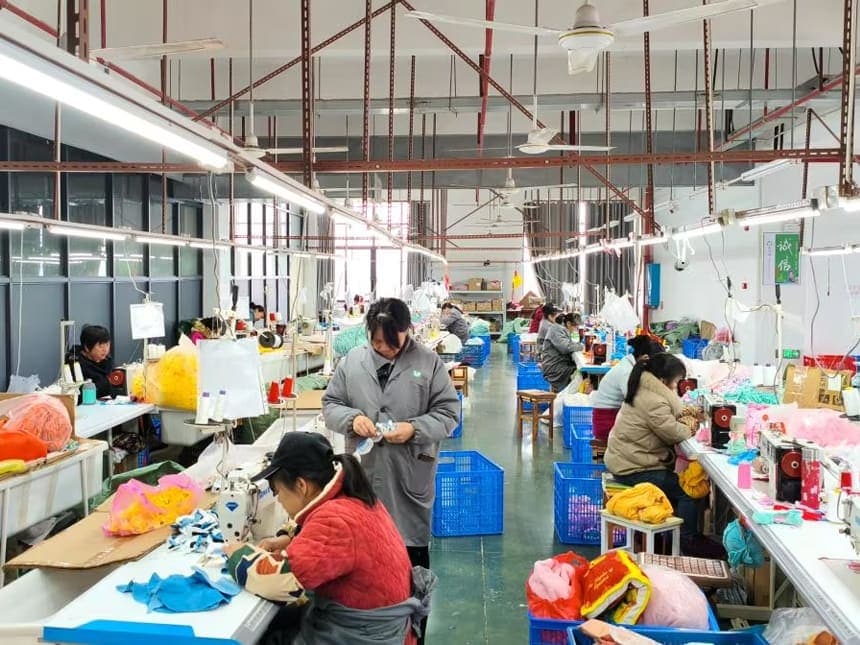
Fabric & two-sided readability: designing for the glance
Reversible mood plush rely on short-pile plush or minky, because the design needs crisp, flat two-tone color blocks and clean embroidered facial features; long shaggy pile would blur the color split and bury the face. The design rule competitors never mention: both faces must read instantly. Each mood needs strong color contrast (the classic warm/angry vs cool/calm split), a clear expression, and enough difference that someone across a room knows which side is showing. For the broader fabric picture, see our fabric & materials guide.
Sizes, MOQ & why two faces cost more
The iconic mini is about 4 inches (~10 cm); production sizes commonly run ~10–20 cm, with giant and pillow versions too. A reversible toy is effectively two decorated shells in one, so it roughly doubles the embroidery and panel count and adds a functional seam — raising labor, sampling complexity and MOQ versus a single-face plush of the same size:
| Factor | Single-face plush | Reversible mood plush |
|---|---|---|
| Decorated faces | 1 | 2 (double the embroidery/appliqué) |
| Pattern panels | Baseline | More — two heads + shared body |
| Functional seam | Closure only | Reinforced, sized flip opening |
| QC | Standard | Plus a flip-test on every unit |
| Relative complexity | — | Higher labor & sampling |
For how that complexity translates into a quote, see our MOQ & cost-breakdown guide.
Safety, compliance & the IP you must clear
A reversible plush is a soft toy, so it's regulated like one: ASTM F963 under the CPSIA in the US (third-party testing, small-parts pull tests on embroidered eyes, flammability) and EN 71 with CE marking in the EU. The reversible-specific angle: because it's designed to be turned inside-out repeatedly, the flip opening and its seams take cyclic stress, so seam-strength and secure-closure testing aren't generic — they target this category's actual failure point. Details in our safety standards guide.
One more thing to clear before you produce: TeeTurtle holds a granted US utility patent on a reversible-toy mechanism (US 10,786,746 B2) and asserts further design-patent and trade-dress rights. That means the flip mechanism is live IP, not a free-for-all. Design your own original characters and faces, and clear your specific design with legal counsel before a run — a responsible factory will build your original design, not copy an existing product.
Make your own reversible mood plush
Bring us your original characters and the two moods you want them to flip between, and we'll engineer the reversible shell, reinforce the flip seam, and certify to ASTM F963 / EN 71. Start on our contact page, request a sample, or browse our customer case portfolio.
Häufig gestellte Fragen
How does the flip actually work?
Is there separate stuffing for each side?
Why do reversible plush cost more than a normal plush?
Can I make my own reversible mood plush design?
Are reversible plush safe for kids, and what standards apply?
Bereit für Ihr eigenes Custom-Plüschtier?
Beschreiben Sie kurz Ihr Projekt — Sie erhalten innerhalb von 1 Geschäftsstunde ein Angebot direkt ab Fabrik.