Plush Toy Certifications Explained: OEKO-TEX, GOTS, GRS, BSCI, ISO & More
The alphabet soup decoded — which plush certifications are mandatory vs voluntary, what OEKO-TEX, GOTS, GRS, BSCI, ICTI and ISO 9001 each cover, which to ask for, and how to spot a fake.

Ask a factory for its certifications and you'll get an alphabet soup — OEKO-TEX, GOTS, GRS, BSCI, SMETA, ICTI, ISO 9001, plus SGS and Intertek test reports. Most of them aren't legally required, several aren't even “certificates,” and they cover completely different things. This is the buyer's decoder: what each one actually proves, which you should ask for and when, and how to tell a real certificate from an edited PDF.
Certification vs audit vs test report
Start here, because buyers conflate three different things. A certification (OEKO-TEX, GOTS, GRS, ISO 9001) is an ongoing, audited status you hold and can look up in a registry. An audit / monitoring scheme (amfori BSCI, Sedex SMETA) produces a report or rating, not a pass/fail certificate. And a test report (an SGS or Intertek lab test to ASTM F963 or EN 71) is a one-off result for one sample against one standard. Knowing which is which is half the battle.
The certifications at a glance
The master view — note the mandatory rows are the legal floor (covered in depth in our safety standards guide); everything else is voluntary but often demanded by retailers:
| Name | Category | What it covers | Type | Mandatory? |
|---|---|---|---|---|
| ASTM F963 / CPSIA (CPC) | Safety (US) | Toy mechanical, flammability, chemical | Test + certificate | Yes (US) |
| EN 71 / CE | Safety (EU) | Toy safety, the EU legal floor | Test + marking | Yes (EU) |
| OEKO-TEX STANDARD 100 | Material / chemical | 1,000+ harmful substances in the textile | Certification | Voluntary |
| GOTS | Sustainability / organic | Organic fiber + eco + social, whole chain | Certification | Voluntary |
| GRS | Sustainability / recycled | Recycled content + chain of custody | Certification | Voluntary |
| amfori BSCI | Social compliance | Labor conditions (A–E rating) | Audit (not a cert) | Voluntary |
| Sedex / SMETA | Social compliance | Ethical audit (2- or 4-pillar) | Audit (not a cert) | Voluntary |
| ICTI / ESCP | Social (toy industry) | Toy-factory worker welfare | Audit / program | Voluntary |
| ISO 9001 | Quality management | Consistent quality processes | Certification | Voluntary |
Material safety: OEKO-TEX STANDARD 100
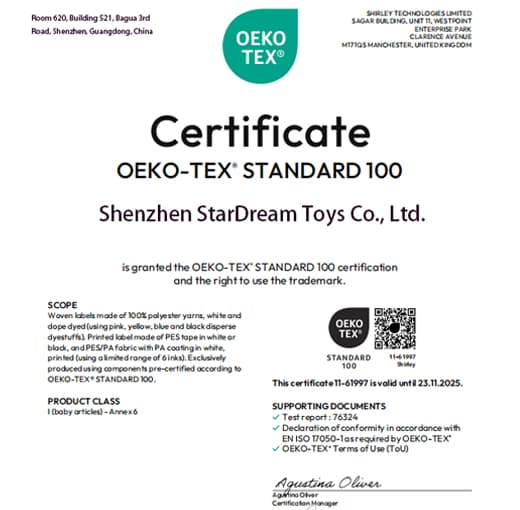
OEKO-TEX STANDARD 100 tests every component — thread, fabric, button, coating — against a list of 1,000+ harmful substances. It has four product classes by skin contact, and Product Class 1 (babies and toddlers up to 3) is the strictest. Two things to remember: certificates are valid one year (so check the date), and it proves chemical safety only — notmechanical toy safety. It's the material cert most baby-plush buyers ask for.
Sustainability: GOTS, GRS & RCS
For eco claims, three different certifications cover three different things:
- GOTS (Global Organic Textile Standard) — organic fiber (≥95% for “organic,” ≥70% for “made with organic”) plus ecological processing and social criteria, certified at every stage of the chain.
- GRS (Global Recycled Standard, by Textile Exchange) — verifies recycled content (≥20%, and ≥50% to use the logo) and the full chain of custody, plus social, environmental and chemical criteria.
- RCS (Recycled Claim Standard) — verifies recycled content and chain of custody only— no social/eco layer. The lighter cousin of GRS.
The clarifier buyers need: organic ≠ recycled ≠ low-chemical— they're three separate claims. More on eco materials in our eco & sustainable plush guide.
Social compliance: BSCI, SMETA & ICTI
These check how the factory treats its workers, not the product — and crucially, they're audits, not pass/fail certificates. amfori BSCI produces an audit report rated A (Very Good) to E (Unacceptable) against a code built on ILO conventions. Sedex / SMETAis the most widely used ethical-audit methodology (2-pillar labor + health/safety, or 4-pillar adding environment + ethics). And the toy industry's own scheme is the ICTI Ethical Toy Program, now the Ethical Supply Chain Program (ESCP) — focused on toy-factory worker welfare. None of them say anything about product safety.
Quality & the test labs
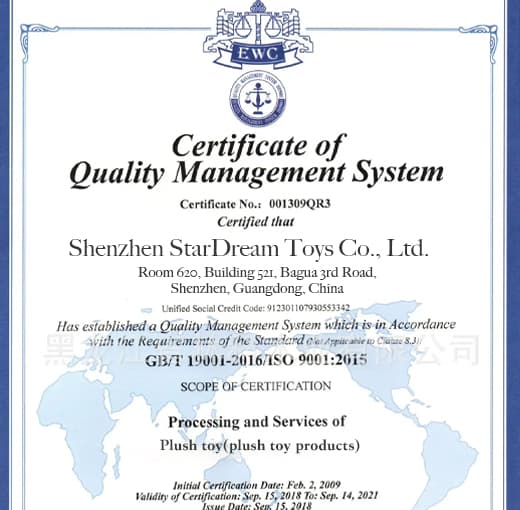
ISO 9001 (the 2015 version) certifies a factory's quality management system— how consistently it runs its processes. It says nothing about product safety, chemicals or labor; it's about repeatability. And the names you'll see on test reports — SGS, Bureau Veritas, Intertek, TÜV — are the testing-and-inspection labs that actually run the ASTM F963 / EN 71 tests behind a CPC or CE mark. A report from one of them is a test result, not the same as holding a certification.
Which do you need — and is it real?
| Your goal | Ask for |
|---|---|
| Sell in the US / EU at all | ASTM F963 + CPC (US) / EN 71 + CE (EU) — first |
| Organic baby line | GOTS + OEKO-TEX (Class 1) |
| Recycled / eco claim | GRS (or RCS for content only) |
| Retailer needs ethical sourcing | amfori BSCI or Sedex SMETA |
| Major toy brand / licensor | ICTI ESCP |
| Quality assurance | ISO 9001 |
Verify OEKO-TEX on its Label Check, GOTS and GRS in their public databases (ask for the Scope and Transaction Certificates), and a BSCI or SMETA audit by its reference on the amfori/Sedex platform. The mandatory floor is in our safety standards guide and the inspection side in our QC & AQL guide.
Ask for the right certifications
Tell us your market and your claims and we'll supply the right, current certifications and test reports — and the numbers to verify them yourself. Start on our contact page, request a sample, or read our guide to vetting Chinese plush factories.
자주 묻는 질문
What certifications should a plush toy factory have?
What's the difference between OEKO-TEX and GOTS?
Is BSCI a safety certification?
How do I check if a certificate is real?
What's the difference between a test report and a certification?
나만의 커스텀 인형 제작을 시작해 보세요
계획 중인 프로젝트를 알려주시면 영업시간 기준 1시간 이내에 공장 직접 견적을 보내드립니다.