인터랙티브·전자 봉제인형: 기능, 모듈, 배터리 안전 규정
소리·빛·녹음·움직임 봉제인형 — 그 뒤의 모듈과 배터리, 그리고 많은 이가 놓치는 규정: Reese's Law / UL 4200A, ASTM F963 §4.25, EN 62115, EN 71 소음 한도, Bluetooth용 FCC/CE.

An interactive plush is an electronics product wearing a soft-toy costume — and that's exactly where buyers get caught. Most plush content ignores electronics; most electronics-safety content isn't about toys. This guide sits in the gap: the features you can build into a plush, the modules and batteries behind them, and the battery and safety compliance that turns a cute idea into a shippable product.
Electronics in a soft costume
The moment a plush gains a sound chip, an LED or a battery, it crosses from soft goods into regulated electronics on top of regulated toys. The single most common — and most expensive — mistake is treating the compliance as a logo to add at the end. It has to be designed in: the battery compartment, the warning labels, the sound level and the testing all shape the product from the first sketch.
The interactive feature menu
Each feature pulls in a different module, battery and compliance trigger. The table maps the common options so you can scope cost and testing before committing.
| Feature | Typical module | Battery | Cost add | Key compliance trigger |
|---|---|---|---|---|
| Pre-recorded push-button sound | Single-track chip + speaker | 3× LR44 / AG13 | $ | ASTM F963 §4.25 compartment; EN 62115; EN 71 sound limit |
| Motion / squeeze sound | Chip + tilt or vibration sensor | LR44 / AG13 or AAA | $$ | + drop/abuse robustness; sound limit |
| Recordable / 'mimic' repeat | Record + playback chip + mic | AAA or button cell | $$ | Same battery rules; mic durability |
| LED / light-up | LED driver | Button cell or AAA | $ | EN 62115 heat/insulation; secured compartment |
| Vibration / animatronic | Motor + gears + PCB | AA / AAA | $$$ | EN 62115 temperature; small parts; pinch points |
| Bluetooth / app smart plush | BLE module + PCB | Rechargeable / AAA | $$$$ | + FCC Part 15 / CE RED; data privacy |
Why button batteries are the big risk
Button and coin cells are the reason this category is so heavily regulated. A swallowed coin cell can cause serious internal injury in as little as two hours, and the CPSC documented thousands of emergency-room visits and dozens of deaths over a decade. That is what drove the United States to pass Reese's Law in 2022, and it is why a child-resistant battery compartment is the non-negotiable core of any compliant interactive plush.
US compliance: Reese's Law & ASTM F963
Here is the nuance most plush sellers get wrong. Reese's Law produced two CPSC rules. General consumer products containing button cells fall under 16 CFR Part 1263, which incorporates ANSI/UL 4200A. But toys are carved out of Part 1263 when they meet the battery requirements of the mandatory toy standard ASTM F963 (16 CFR Part 1250), whose §4.25 governs button-cell accessibility and labeling — and the CPSC moved in 2024 to strengthen those toy requirements. Practically, a compliant interactive plush needs:
- A child-resistant compartment — battery not accessible without a tool or two simultaneous actions, and secure after drop/crush/torque abuse testing.
- Warning labels on the product (where practicable), the packaging and the instructions, covering the swallowing hazard and what to do if a battery is ingested.
For the broader US/EU toy testing picture, see our safety standards guide and our QC & AQL inspection guide for how function testing fits the inspection flow. (See the CPSC button-cell guidance for the source detail.)
EU: EN 62115, EN 71 & sound limits
Any toy with an electrical function must meet EN/IEC 62115 (Electric toys — Safety) — covering insulation, wiring integrity, battery-compartment robustness, overheating and charging — applied alongside EN 71. EN 71-1 also secures battery compartments (tool or two-action access, mirroring the US rule) and sets the acoustic limits that protect children's hearing. Measured at 50 cm, EN 71-1 typically caps table-top and hand-held toys around 80–90 dB and close-to-the-ear toys far lower, around 60–70 dB, with a C-weighted peak near 110 dB. Because children press plush to their ears, design sound modules to the conservative category.
Bluetooth: FCC & CE RED
A connected, app-driven plush adds radio compliance on top of toy safety. For the US, the Bluetooth radio is an intentional radiator requiring FCC Part 15 equipment authorization, tested on the final product. For the EU, you need CE marking under the Radio Equipment Directive (RED), usually with EMC requirements. Connected toys may also raise data-privacy expectations. Every wireless feature adds lead time and testing cost — budget for it up front.
Manufacturing & QC realities
- Insertion. The module sits in a sewn-in seam pocket; a screw-secured battery box gives the compliant access. The youngest age grades use fully sealed, non-replaceable units.
- Not washable. Electronics are surface-clean only — design and label accordingly, and test for water ingress where relevant.
- 100% function test. Unlike cosmetic defects that are AQL-sampled, every electronic unit is function-tested — not a sample.
- Metal detection still applies. The speaker magnet and battery are metal, so the needle/metal-detection step has to be calibrated to pass the module while still catching a broken needle.
- 1Feature specWhat it does, age grade, close-to-ear?
- 2Module + batteryButton cell vs AAA; sound dB target
- 3Toy under 14?Yes → ASTM F963 §4.25 · No → Part 1263 / UL 4200A
- 4Compliant compartmentTool or two-action; secure after abuse
- 5Warning labelsProduct + packaging + manual
- 6Safety testingEN 62115, EN 71 dB, + FCC/RED if wireless
- 7100% function QCEvery unit; metal detection calibrated
Build interactive plush that passes
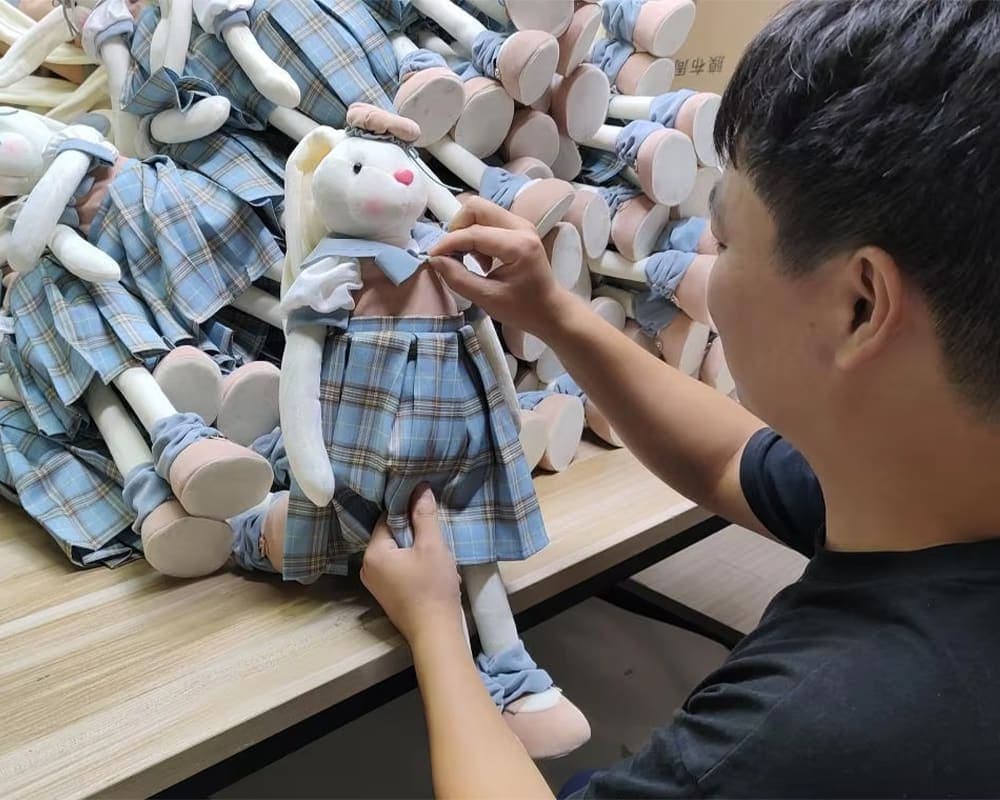
We design the battery box, sound level and module integration to clear ASTM F963 / EN 62115 / EN 71 from the first sample, and we function-test every unit. Bring your feature idea and target market to our contact page, see finished work in our customer case portfolio, or start with the build basics in our plush design & tech-pack guide.