ぬいぐるみのパッケージ&輸出ガイド:小売対応・法令準拠・出荷可能
小売パッケージ形式、米国/EUの必須安全表示、バーコード、輸出カートン仕様、サステナブル選択肢、MOQ/コスト — 輸入者のための完全なぬいぐるみ梱包ガイド。

Packaging is where a custom plush program quietly wins or loses money. The same toy can sail through customs and onto a retail shelf — or get held at the border, rejected by an Amazon listing, or returned by a buyer — purely on how it is labelled, boxed and shipped. This guide connects the four things every importer has to get right at once: retail packaging design, mandatory safety labelling (US + EU), barcodes, and export carton logistics — written from the factory floor, not a packaging catalogue.
Packaging is a sourcing decision, not an afterthought
Buyers tend to lock the toy spec first and treat packaging as a finishing touch a week before shipment. That is backwards. Packaging format drives your unit cost, your minimum order quantity, your retail acceptance, and your compliance exposure. A gift box can add more to the landed cost than the plush itself; a missing warning label can void a whole shipment. Decide the packaging at quote stage, alongside the toy — not at the end.
Retail packaging formats for plush — and when to use each
There is no single “best” format — only the right fit for your channel, price point and sustainability target. Scan the table, then read the notes below it.
| Format | Best for | Relative unit cost | Typical MOQ | Barcode & warnings? |
|---|---|---|---|---|
| Hangtag / header card | Hanging display, soft toys needing no box | $ (cents) | 500–1,000 | Yes — prints barcode + care + warnings |
| Belly band | Boutique / gift positioning, low-waste | $ (cents) | 500–1,000 | Limited surface — pair with sewn-in label |
| Window / gift box (rigid) | Premium, collector, giftset SKUs | $$$ ($1.5–6.8+) | 500–2,000 | Yes — large branded surface |
| Mailer box | DTC / e-commerce ship-and-display | $$ | 300–1,000 | Yes |
| Polybag (OPP/PE) | Bulk, wholesale, lowest cost | $ (cents) | 1,000+ | Must carry suffocation warning + vent holes |
| Drawstring cloth pouch | Reusable, premium, plastic-free | $$ | 500+ | Add sewn-in label / hangtag |
| Blind box | Collectible / promotional series | $$–$$$ | 1,000+ | Yes — outer carton + per-unit barcode |
The hangtag is the cheapest brandable format and carries everything a retailer needs — brand story, care instructions, the barcode and the safety warnings — which is why it is the default for most soft toys. Step up to a window box only when the unboxing is part of the product (collector lines, premium gifts). A bare polybag is fine for wholesale, but it is the format most often rejected at retail because the suffocation warning was skipped — more on that next.
Mandatory safety & warning labelling
This is the section that gets shipments rejected. The requirements differ by destination market and sales channel — here are the ones that actually apply to plush.
US — CPSIA tracking label
Every children's product (age 12 and under) needs a permanent CPSIA tracking label on both the toy and the packaging, identifying four things: manufacturer/importer name, production location, production date, and the batch or run number. On plush we sew this into a fabric label and repeat it on the hangtag or box. It has been mandatory under CPSIA Section 103(a) for items made on or after 14 August 2009.
US — ASTM F963 choking / small-parts warnings
Since ASTM F963 became mandatory on 20 April 2024, any toy or detached part that fits inside the small-parts cylinder fails for under-3 use. Toys with small parts intended for ages 3–6 must carry the choking-hazard warning, e.g. “WARNING: CHOKING HAZARD — Small parts. Not for children under 3 yrs.” For plush this usually means embroidered eyes for the baby band rather than plastic safety eyes.
US — polybag suffocation warning
Five states (CA, NY, MA, VA, RI) plus New York City and Chicago require a suffocation warning on thin film (under 1 mil). Amazon requires it once the bag opening reaches 5 inches and recommends bags of at least 1.5 mil; Target requires it on every polybag regardless of size. Because the strictest retailer policy is the safe default, we print the warning on all polybags and punch vent holes as standard.
EU — CE mark + EN 71 age warnings
For the EU the CE mark must be visible, legible and at least 5 mm high — on the toy, or at least on the packaging if it is not visible through it. Toys not suitable for under-3s must show the “Not suitable for children under 36 months” wording or the age-warning symbol per EN 71-1, and the packaging must carry the manufacturer/distributor name and address.
Country-of-origin marking
US imports must be conspicuously marked with the country of origin (e.g. “Made in China”) in English, legible to the ultimate purchaser. It is a small line of text that, if missing, holds your container at customs.
Barcodes: GTIN / UPC / EAN — get them right the first time
A GTIN is the underlying number; GTIN-12 is a UPC (North America), GTIN-13 is an EAN (Europe and most of the world). Get them from GS1 — the only legitimate issuer. A single GS1 US GTIN is about US$30 with no annual renewal; a Company Prefix scales for a full line. The rule importers forget: every variant — each size and each colour — needs its own unique GTIN, or Amazon, Walmart and Target will reject the listing. Send us the numbers and we print the barcode onto the hangtag or box and verify it scans before mass production.
Export packaging: inner carton, master carton & shipping marks
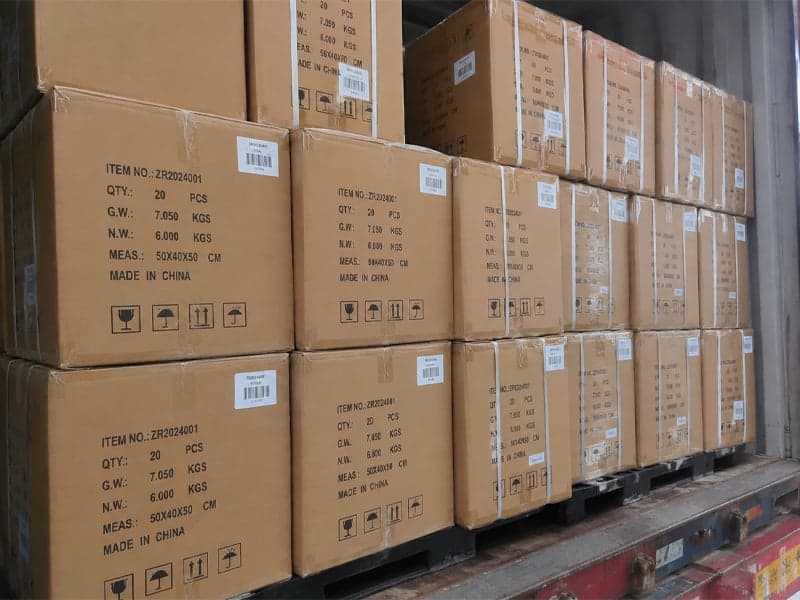
Retail packaging sells the toy; export packaging gets it across the ocean intact. Think in three layers: the retail unit (polybagged individually), packed into an inner carton, packed into a master carton. The master carton is what customs, freight forwarders and the receiving warehouse actually read.
A compliant master carton carries:
- Buyer name / logo, PO or style reference, destination country
- SKU and barcode — placed on the carton's short side so it stays visible when cartons are stacked
- Carton number in the series (“1 of 240”), and net & gross weight
- Carton dimensions (L×W×H) and handling symbols (fragile, keep dry)
- Marks that exactly match the packing list — mismatches trigger customs holds
Two plush-specific realities: cartons are built to roughly 15–20 kg so one worker can lift them (heavier risks retailer rejection), and soft goods absorb humidity, so we add moisture-resistant liners and desiccant to prevent mildew on a long ocean leg. Every ocean container also needs a Verified Gross Mass (VGM) declaration before loading.
- 1Confirm target marketUS: tracking label + F963 + origin · EU: CE + EN 71
- 2Choose retail formatHangtag / box / polybag + GTIN barcode
- 3Add mandatory warningsSuffocation, choking, age grade
- 4Build the 3-layer packUnit → inner carton → master carton
- 5Mark cartons + VGMShipping marks, weights, moisture protection
- 6ShipCustoms-ready and retailer-ready
Sustainable packaging that buyers and retailers now expect
Retail sustainability scorecards increasingly grade packaging, and the toy majors have moved hard toward paper. The practical wins for plush are: switch to FSC-certified paper for hangtags and boxes, use soy- or water-based inks, and — the biggest single reduction — replace or shrink the polybag with a belly band or a reusable drawstring pouch. If you keep the polybag, recycled-content PE with vent holes is the baseline. For the fabric and fill side of “eco” claims, see our guide to sustainable plush materials & certifications.
Packaging cost & MOQ: what drives your per-unit price
Tooling and printing plates are fixed costs amortised over volume: an US$800 die is $0.80 per unit at 1,000 pieces but only $0.08 at 10,000. That single fact explains most packaging-cost surprises. Offset-printed rigid boxes carry a 500–2,000 MOQ and the lowest per-unit cost at scale; digital-printed boxes skip the plates and run as low as 50–250 pieces with a 7–10 day lead time, but cost more each. Finishes — foil, emboss, soft-touch lamination — add roughly $0.10–$1.50+ per unit.
Brief us once, ship compliant
Send us your target markets and channels at quote stage and we build the packaging spec alongside the toy: dual US/EU compliant artwork, barcodes verified to scan, retail-ready units, and export cartons marked to match your packing list. Start a project on our contact page, see real packed orders in our customer case portfolio, or read the plush safety standards guide for the testing behind the labels.