가중·감각 봉제인형 제조: 충전재·무게·안전·정직한 표현
가중 봉제인형이 실제로 만들어지는 법: 유리 마이크로비즈 대 플라스틱 펠릿, 체중 비례가 아닌 편안함 기준 무게, 누출을 막는 비즈 봉입 설계, 완구 규정, 영아 안전 경계선, 그리고 정직한 비의료적 마케팅.

Weighted plush has jumped from a niche into a category, riding the comfort-object trend. But making one well is a manufacturing problem, not a marketing one: the wrong fill feels lumpy, a weak seam turns loose beads into a choking hazard, and an over-eager health claim is a legal liability. This is the honest, factory-side guide — fill, weight, containment, safety, and the two lines you must not cross.
Why weighted plush is booming (the honest version)
The rationale customers cite is deep touch pressure (DTP)— gentle, even, hug-like pressure that many people report as calming. It's worth being straight about the evidence: peer-reviewed research on DTP is mixed and highly individual — effects vary by person and aren't a proven medical treatment. So we design weighted plush as a comfort product people enjoy, and we keep the marketing honest (more on that below).
Choosing the weight fill
The fill decides feel, washability, sound, safety and cost. Here's the manufacturer's view:
| Fill | Density vs PP | Washability | Sound | Cost | Best for / notes |
|---|---|---|---|---|---|
| Glass microbeads (1–2 mm) | ~2.5× | Machine-wash tolerant | Near-silent | $$$ | Premium plush; smooth even weight, less bulk |
| Poly (PP) pellets | 1× (baseline) | Machine-wash | Slight rustle | $$ | Budget builds; can feel lumpier |
| Sand / mineral | High | Not washable (clumps, mildew) | Quiet | $ | Avoid for quality plush |
| Steel shot | Very high | Rust risk | Noisy | $$$$ | Niche only |
For premium plush we default to glass microbeads: their higher density hits the target weight in less volume, so the weight feels smooth rather than lumpy, and they're near-silent and wash-tolerant. For the broader material picture, see our fabric & materials guide.
How heavy should it be?
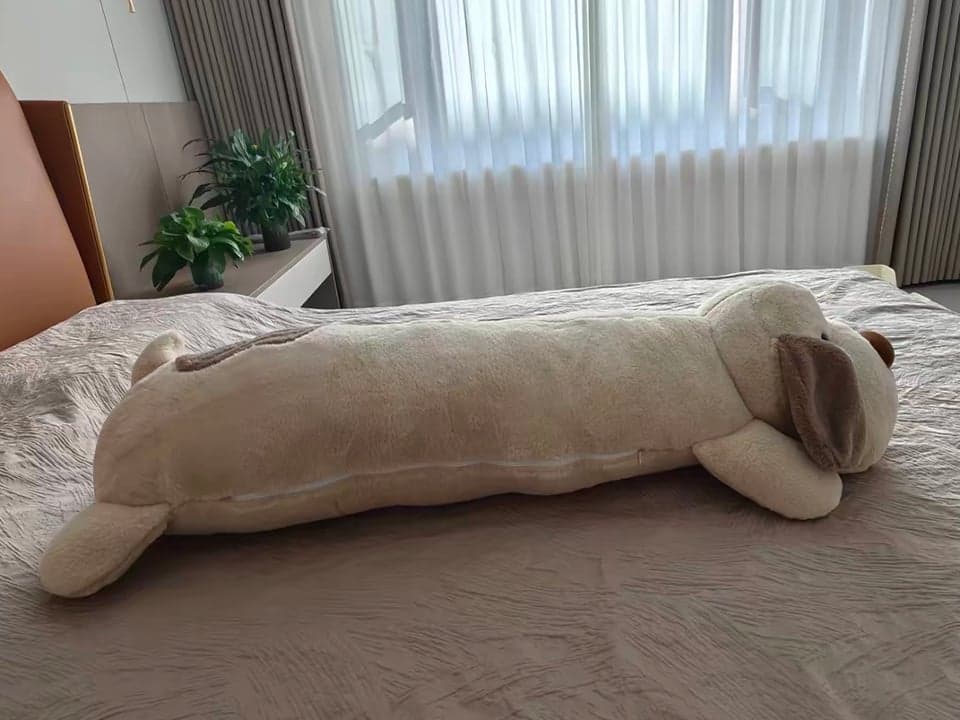
A common mistake is to copy the weighted-blanket rule of thumb — about 10% of body weight — onto a plush. Don't. A weighted blanket drapes over the whole body; a weighted plushis a comfort object held in the lap or against the chest, so it's chosen for comfortable holding, not scaled to body weight. Most land around 1.5–5 lb (≈0.7–2.3 kg) — heavy enough to feel reassuring, light enough to hold for 10–20 minutes without straining wrists or shoulders. Larger body-pillow styles can run 5–8 lb across multiple compartments.
| Use case | Typical weight | Note |
|---|---|---|
| Toddler comfort plush | Not weighted / very light | Weight not appropriate at this age |
| Older-child lap buddy | ~1.5–2.5 lb | Comfortable to hold and carry |
| Teen / adult comfort plush | ~3–5 lb | The popular 'calming companion' range |
| Body-pillow style | ~5–8 lb | Multi-compartment to distribute weight |
The infant-safety line
This is non-negotiable. Weighted products are not for babies. The CPSC advises against weighted blankets and swaddles for infants, citing suffocation risk and reduced oxygen saturation if the weight shifts over a baby's mouth or nose, and major retailers have stopped selling weighted infant products. Weighted plush should be designed and labelled for older children and adults, and never marketed as an infant sleep aid.
Bead containment: preventing leaks
Bead leakage is the highest-severity defect a weighted plush can have — loose glass beads or pellets are a choking and ingestion hazard, and a seam burst can drive a serious recall. So containment is engineered, not assumed:
- Inner liner bag holds the weight media, separate from the outer plush shell.
- Baffles / sewn pockets keep the weight distributed so beads can't migrate or pool.
- Double-stitched, reinforced seams to a strength target appropriate for a frequently-handled, heavier toy.
- Washability by design — usually a removable weighted insert so the shell can be laundered, or a surface-clean spec.
- 1Define use case & age bandRule out infant use
- 2Set target weightComfort-based (~1.5–5 lb), not body-weight %
- 3Choose fillGlass beads (premium) / poly pellets (budget)
- 4Design containmentInner liner + baffles/pockets
- 5Reinforce seamsDouble-stitch to strength target
- 6Compliance gateSmall-parts + bead-leak/seam-burst → ASTM F963 / EN 71
- 7Honest-claims review & shipFTC: no medical claims; weight-driven freight
Sensory features beyond weight
Weight is one sensory lever; there are others. Textures — ribbed fabric, crinkle panels, satin tags, minky — add tactile interest. Fidget elements and scent extend the sensory appeal. Two variants add safety duties: warming (microwavable grain/lavender inserts) needs clear heating-time labelling and flammability caution, and vibrating features pull in the battery and electronics rules covered in our interactive & electronic plush guide.
Safety & honest, non-medical claims
A weighted plush for children is still a toy, so it must meet ASTM F963 (US) and EN 71 (EU) — small-parts and choking tests, plus the leak/seam-burst testing specific to weighted items — with CPSIA tracking and third-party testing. The other line is marketing: weighted plush are not FDA-cleared medical devices, and the FTC requires health claims to be backed by competent and reliable scientific evidence. Use honest comfort language and avoid “treats anxiety,” “therapeutic” or “clinically proven.” For the full toy-testing detail, see our safety standards guide and how it's checked in our QC & AQL guide.
Build weighted plush the right way
Tell us the use case, target weight and age band, and we'll spec the fill, engineer the bead containment, and certify to ASTM F963 / EN 71 — with marketing language that keeps you on the right side of the FTC. Start on our contact page, browse our customer case portfolio, or go deeper on materials in our fabric & materials guide.